A Day in Kamakura: Temples, Beach, and Enoshima Sunset
From Komachi-dori at breakfast to sunset over Mount Fuji from Enoshima. A round-trip narrative day from Yokohama, with prices and train times.
The 9:14 from Yokohama is half-empty on a January morning. Twenty-five minutes later, the JR Yokosuka Line spits you out at Kamakura Station, the air is dry and 12 degrees, and you can already smell the sea. Mount Fuji is sitting there on the horizon, sharp enough to cut paper. Komachi-dori starts here, and so does the day.
This is one sunny day in Kamakura, done as a round trip from Yokohama. We did it in mid-January with cloudless weather and Fuji visible from breakfast to sunset. Total transit cost (the cheap way back), about ¥1,650. Total entrance fees, around ¥1,600. Total walking, roughly 8 km. The day works any month of the year, but January through February gives you the clearest visibility for Mount Fuji at sunset, and March through October keeps you in t-shirt weather. Pick your trade-off. The full Kamakura destination guide has the deeper context if you want to extend any of these stops into half-day stays.
Komachi-dori at Breakfast Hour
Walk straight out of the station's east exit and Komachi-dori is right there: a 360-meter pedestrian shopping street that funnels visitors from the station up toward Tsurugaoka Hachimangu. Most shops open at 10:00, but a few cafes and the matcha soft-serve stands are running by 9:30, which is exactly the hour you want to be on the street.
What to grab: a matcha soft-serve from one of the half-dozen places selling it (around ¥500), a freshly fried croquette from a butcher's window (¥200 to ¥300), or a pigeon-shaped hato sablé from Toshimaya, the company that has been making them in Kamakura since 1894. A box of five is ¥600. They stay fresh for a week, so they double as a souvenir for someone back home.
Time it right. By 11:30 the street is shoulder-to-shoulder. Before 10:00 you can actually look at the shop windows. Komachi-dori's full page covers the specific shops worth stopping at; the Kamakura page's food section covers shirasu-don and other lunch ideas if you'd rather sit down.
Tsurugaoka Hachimangu
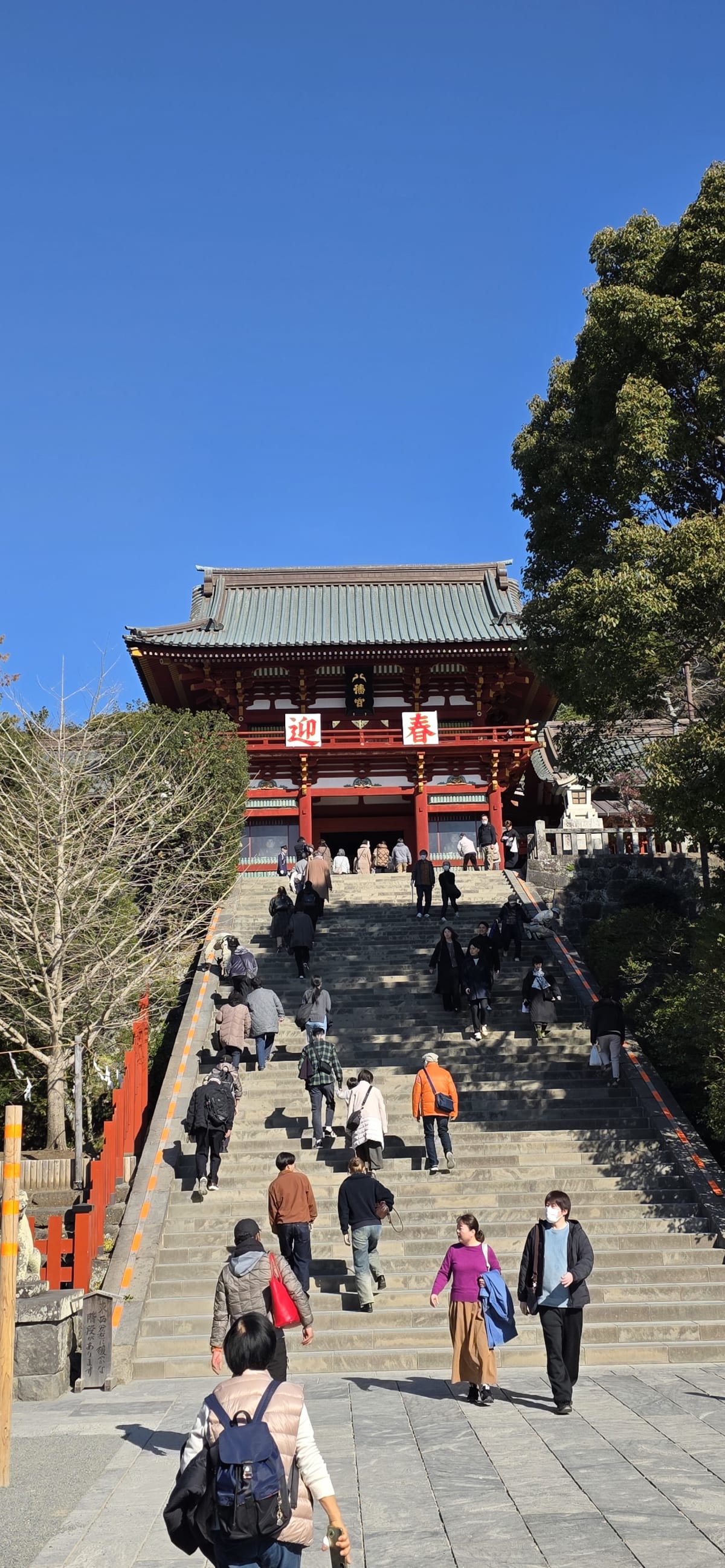
Komachi-dori dead-ends at the wide stone approach (the dankazura) leading to Tsurugaoka Hachimangu. Cherry trees line both sides: pinks in early April, dense green in summer, copper in November. Entry is free, the grounds open at 5:00 from April through September and 6:00 the rest of the year, and the main hall sits at the top of 61 stone steps.
The shrine was founded in 1063 and moved to its current site in 1180 by Minamoto no Yoritomo, the same shogun who made Kamakura the de-facto capital of Japan. The two ponds inside the grounds, the Genji and Heike ponds, were originally planted to symbolise his clan's rise and his rivals' fall. Knowing this changes how you walk the place. The Treasure House (¥500) is worth the detour if you have a soft spot for samurai-era artifacts; otherwise the grounds themselves are the experience.
Allow 45 minutes. More on Tsurugaoka Hachimangu.
Hokokuji: The Other Bamboo Grove
From the shrine, it is a 25-minute walk east, or a quick ride on the bus from Kamakura Station (Bus 5 toward Kanazawa-Hakkei, ¥200, get off at Jomyoji). Hokokuji opens at 9:00 and closes at 4:00. Entry is ¥300, or ¥500 with the matcha set in the back garden, which you should take.
Most travellers know about Arashiyama, the bamboo grove west of Kyoto. They go in the morning, find a thousand other people in the same frame, and leave a little disappointed. Hokokuji is what Arashiyama would feel like if Arashiyama still felt like a temple. About 2,000 stalks of moso bamboo grow on a quiet hillside behind a small zen complex. There is a stone path through them, and at the back, a tea house where a host whisks matcha while you sit on a tatami platform looking out into the grove.
It is, mathematically, a smaller bamboo grove than Arashiyama. It also routinely has fewer than thirty people in it. We had the tea house to ourselves on a Saturday in January, matcha in one hand, the bamboo creaking overhead in a breeze. That trade is worth making. Budget 45 minutes including the matcha. Hokokuji details.
Yuigahama Beach: Surfers and a Snack
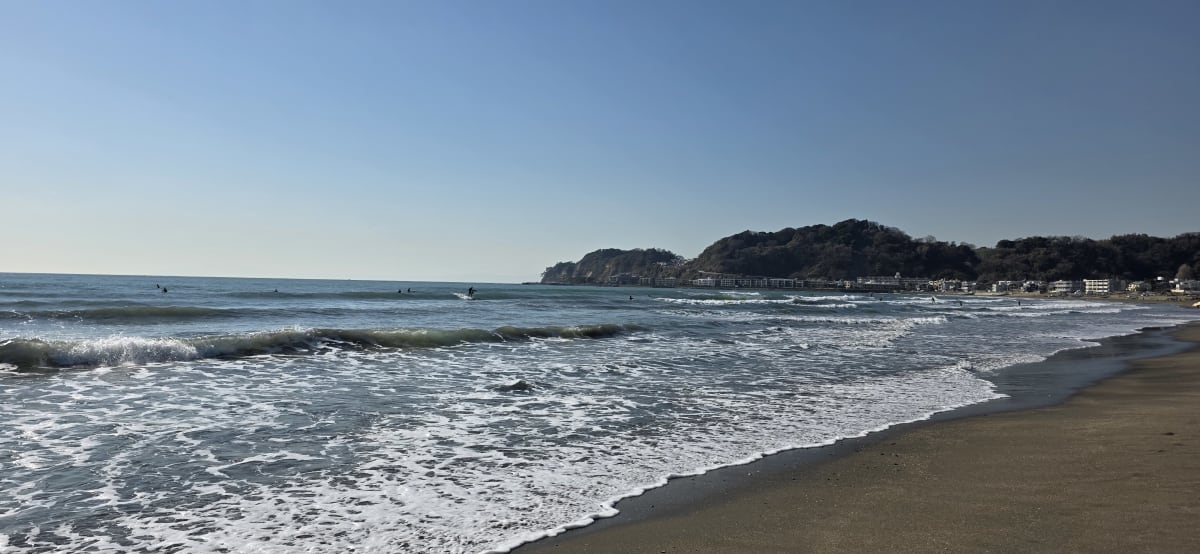
Walk back toward Kamakura Station (or take the bus back, same fare) and switch to the Enoden, the single-track coastal railway that connects Kamakura to Enoshima. From Kamakura Station, ride two stops to Yuigahama (¥200, 4 minutes). The platform is so close to the houses on either side that it feels less like a station and more like someone's back garden.
Yuigahama is a kilometre-long crescent of dark volcanic sand. The water is the Pacific, which is colder than tourists expect. From roughly mid-March to November, the line-up east of the breakwater fills with surfers most weekends; on a sunny morning you'll watch fifty people sit on their boards waiting for sets that come in slow and clean. Beach huts (called umi no ie) appear every July and August and disappear by September, so outside summer the beach is basically yours.
Look west on a clear winter day and Mount Fuji is right there, dead ahead, framed by Enoshima on the left. Buy an iced coffee from the vending machine on the boardwalk (¥160), sit on the low concrete wall, and watch the surfers for fifteen minutes. The whole town slows down here, and that is the point. More about the Hase neighborhood.
Kotoku-in: The Great Buddha
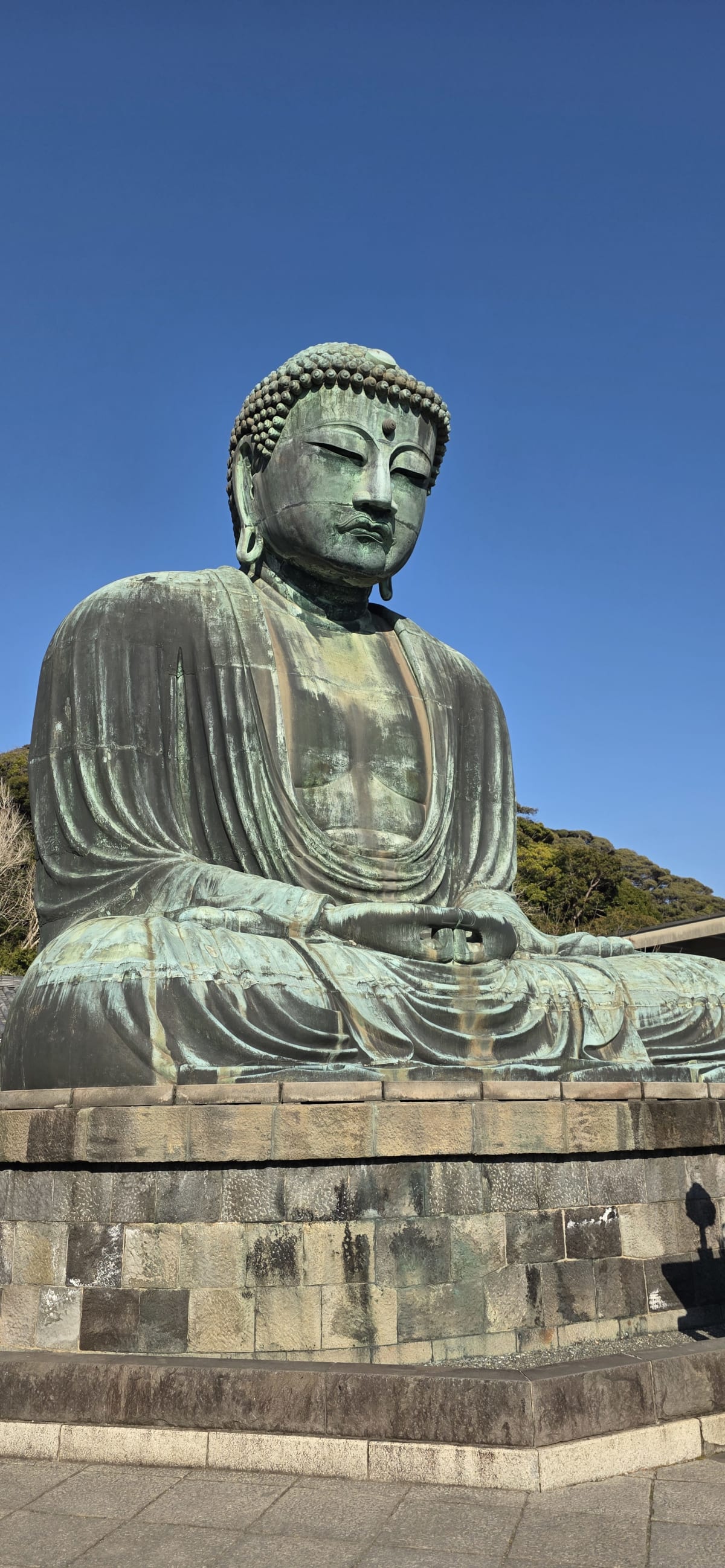
Back on the Enoden, one stop further to Hase (¥200). Walk seven minutes inland and you are at Kotoku-in, the temple that houses the Daibutsu. Open 8:00 to 5:30 (April through September) or 8:00 to 5:00 (October through March). Entry is ¥300. Stepping inside the bronze, through a small door at the back, costs an extra ¥20.
The Buddha was cast in 1252. It is 11.4 metres tall and weighs 121 tonnes. It used to sit inside a wooden hall, but the hall was destroyed by a tsunami in 1498 and never rebuilt, which is why the figure now sits in the open air with sky behind it. The hollow construction is visible from inside if you take the ¥20 add-on, and the seam lines from the casting are still clearly traceable on the bronze surface. There are very few 770-year-old objects you can casually walk up to and touch. This is one.
Forty-five minutes is enough. Full Great Buddha details. If you have an extra hour, Hasedera (¥400, ten minutes back toward the beach) has an 11-headed Kannon statue and an ocean-view terrace; this itinerary skips it to keep moving toward sunset.
The Enoden, Window Right
From Hase, the Enoden continues toward Enoshima. Get a window seat on the right side. The trip is roughly 15 minutes and ¥260, and it is genuinely one of the prettier 15 minutes of train travel in Japan.
The line was built in 1902. Modern carriages run on it, but the route itself has barely changed: tunnels carved through coastal hills, level crossings tight enough to brush the fenders of parked cars, ten-metre stretches where the track runs along an actual road with the train mixed into traffic. Between Kamakurakokomae and Inamuragasaki, the right-hand windows look directly onto the ocean, with surfers and Mount Fuji on the horizon. This stretch is what every Enoden photograph you have ever seen is of.
Get off at Enoshima Station. The next part is on foot.
Crackers, Stairs, and the Sea Candle
From Enoshima Station, walk fifteen minutes south through the seaside town and across the 600-metre Benten Bridge. Enoshima itself is a small island, only about 4 km in circumference, with a steep-sided shrine complex stacked on top. You can climb to the summit on foot (about twenty minutes of stairs), or pay ¥360 each way for the Escar, a series of outdoor escalators that cuts the climb to about ten minutes. The first set is at the bottom of the main steps.
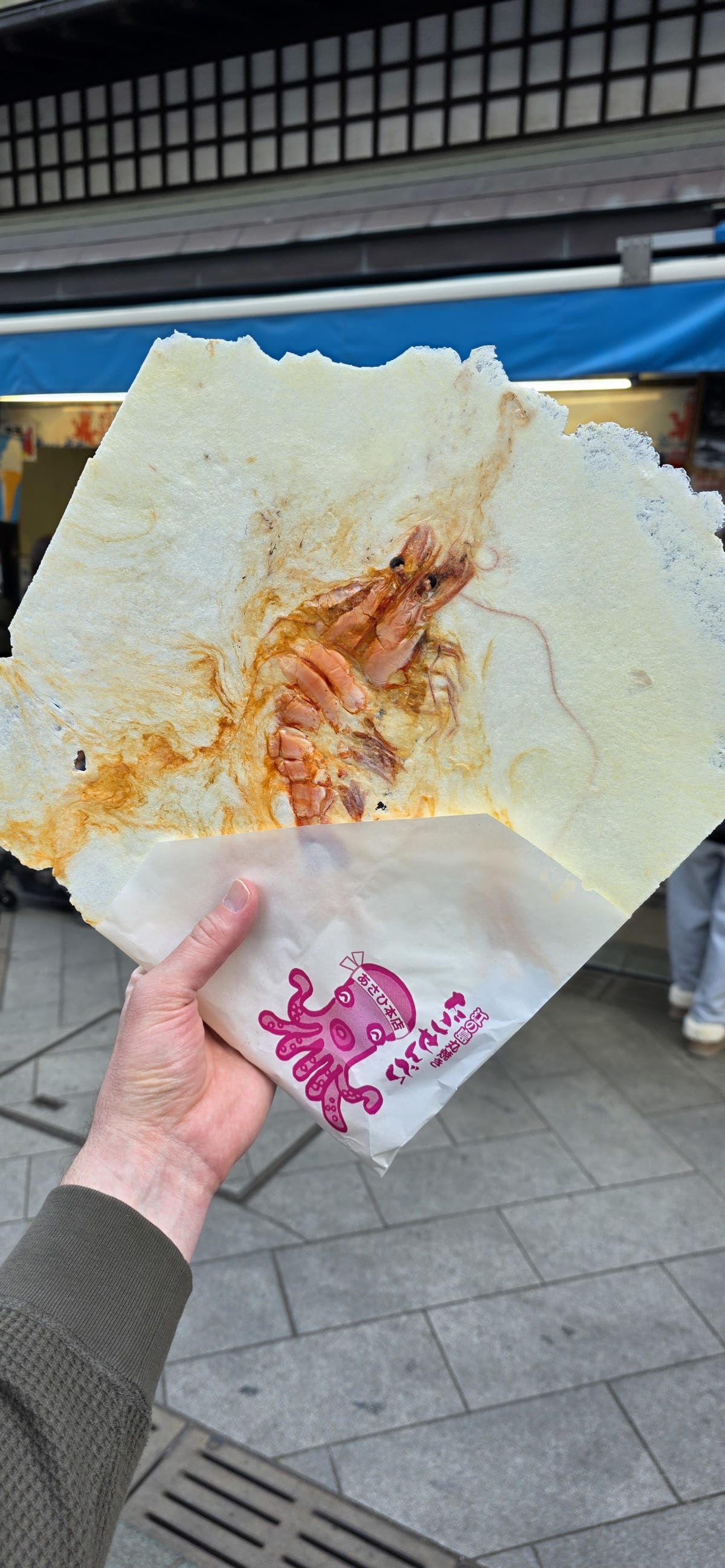
About halfway up, you will hit the Asahi Honten cracker stand. They are famous for the giant senbei pressed flat in front of you on a hot iron, served scorching. Lead with the jumbo prawn cracker (ebi senbei, ¥700), which uses a half-dozen whole shrimp flattened into the dough, the legs and shells turning into edible crisp. The shop's actual signature is the octopus version (tako senbei, ¥600), and that is what the queues are usually for; if you want the iconic Enoshima photograph, that is the one. Order one of each and split them. They are too hot to eat for the first thirty seconds. That is the point.
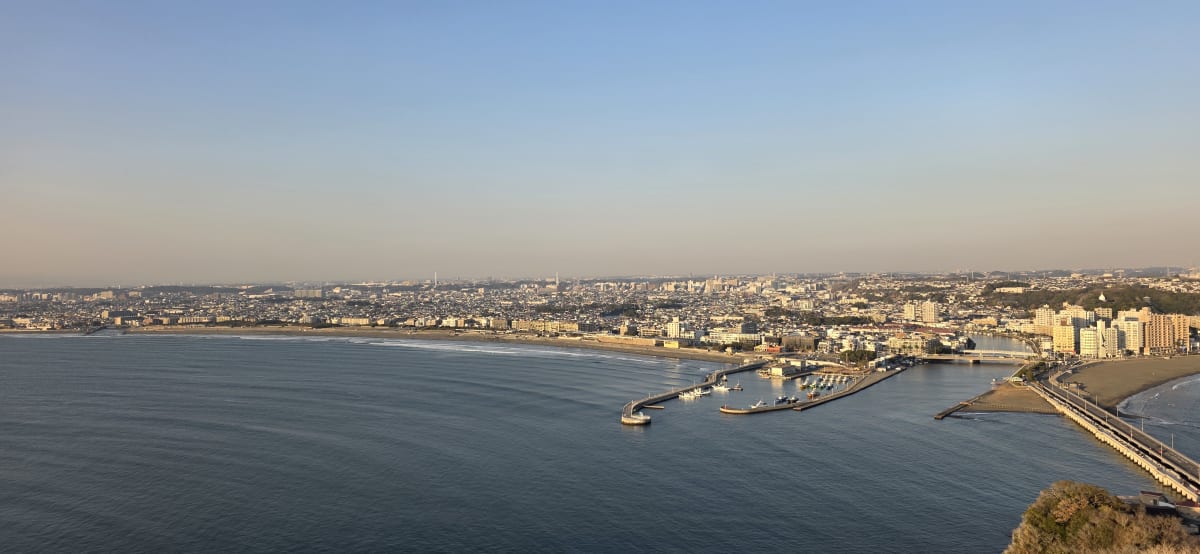
Keep climbing through Enoshima Shrine to the Enoshima Sea Candle, the white observation tower visible from every angle since the bridge. The combo ticket for the Samuel Cocking Garden plus the tower is ¥800. The tower is open until 8:00, and the deck (60 metres above the garden, 119 metres above sea level) takes in the whole bay. More on Enoshima.
Watch the Skies: Enoshima's Kites
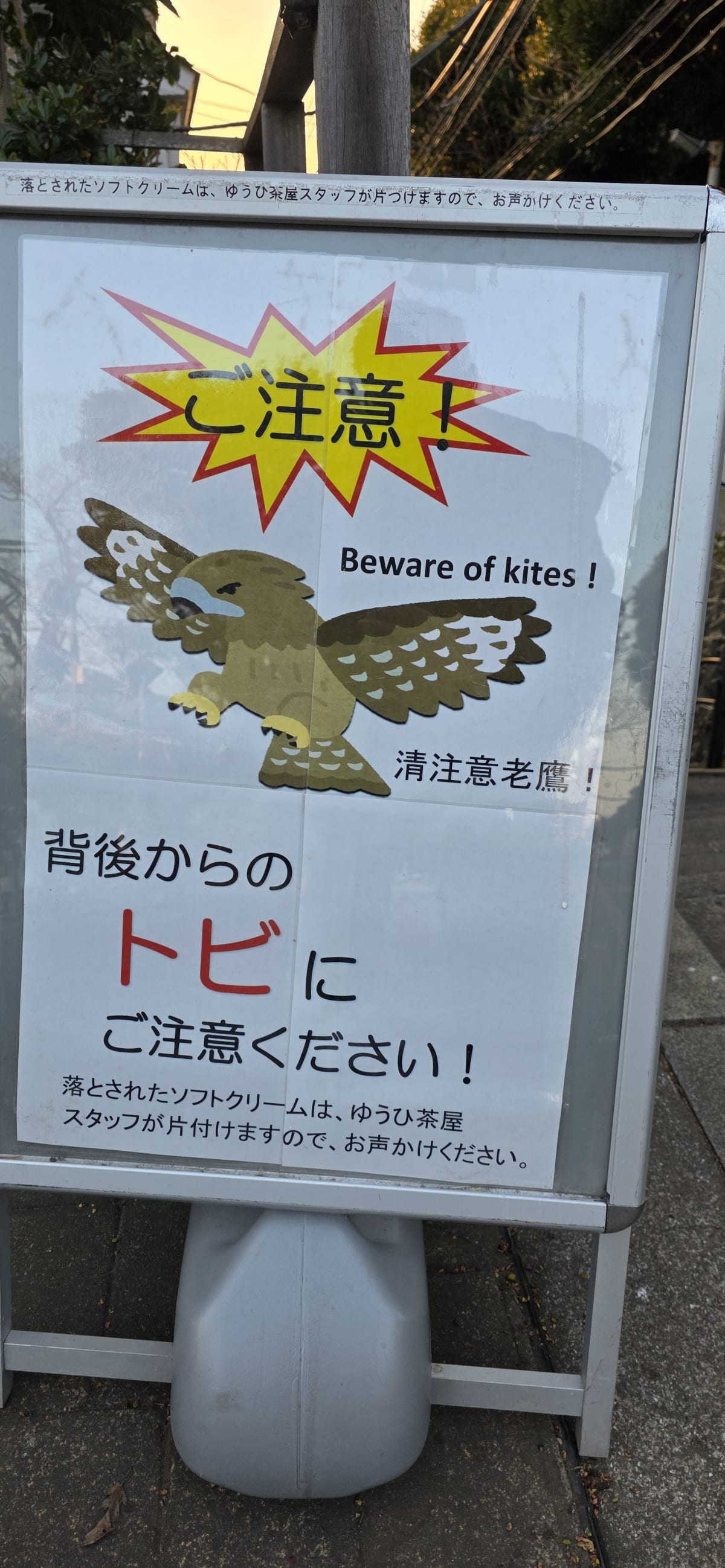
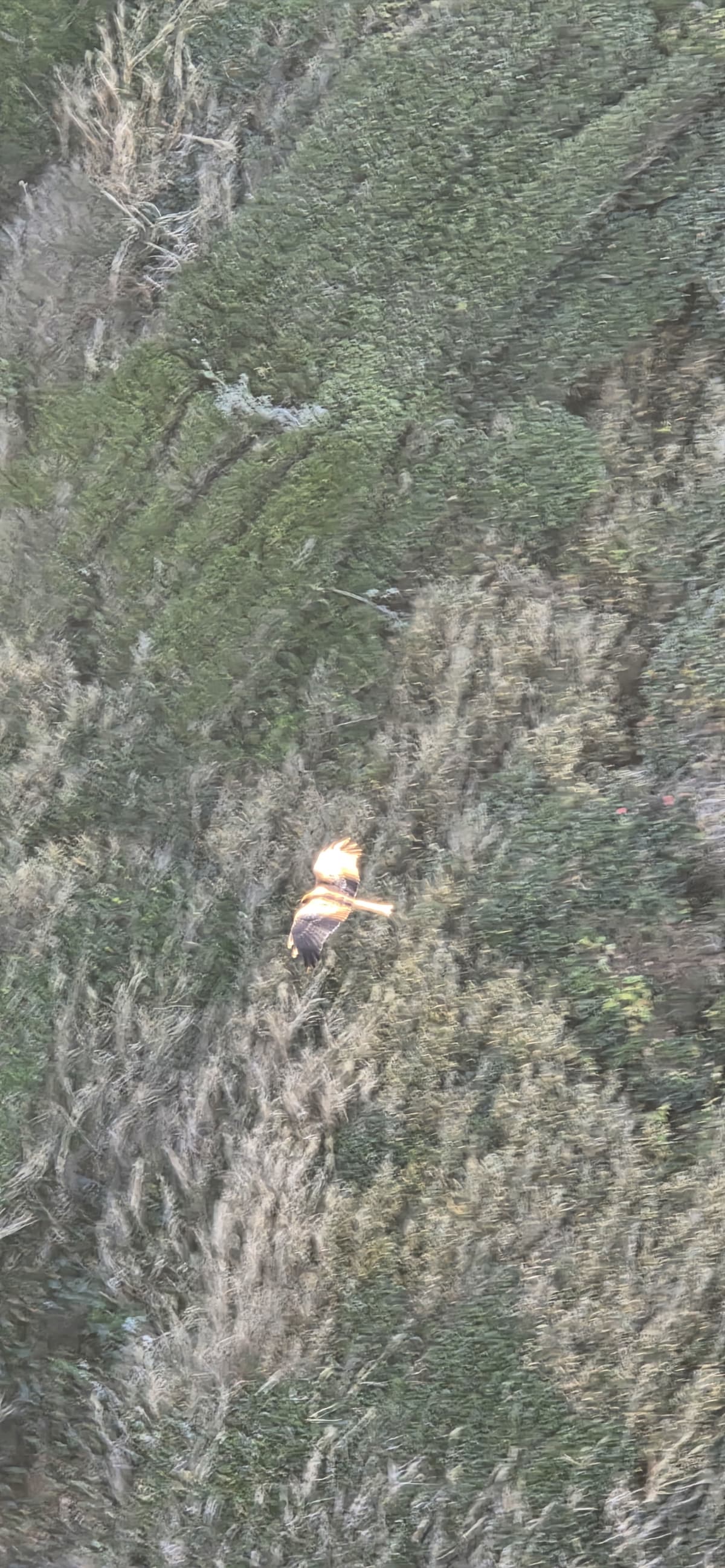
Here is the part nobody warns you about until you read the signs. Enoshima has kites. Not the paper kind. The bird kind. Specifically tobi (鳶), the black kite: a brown raptor with a 1.5-metre wingspan, a forked tail, and a learned habit of stealing food from tourists in broad daylight. They are not hawks (different genus, before anyone in your group corrects you), but they look the part, and at close range with a cracker in your hand they are exactly as intimidating as a hawk would be.
The signs along Benten Bridge and on every viewing terrace spell it out in English and Japanese: do not walk while eating, do not lift food above your head, do not feed them. They are there because every one of those rules has been broken by a tourist who learned the hard way. The kites approach from behind and from above, silently, and they are accurate enough to take a half-eaten taiyaki out of your hand without a scratch on your fingers. We watched it happen on the bridge: a guy in a Patagonia jacket lost his snack to a bird he never saw coming. The kite banked over the water with the pastry still warm.
The strategy is simple. Sit down to eat. Eat against a wall, under cover, or with your back to a building. Keep the cracker pointed inward. We took our two crackers from Asahi Honten, found a low concrete bench tucked under an awning two doors down, ate quickly, and watched at least thirty kites thermal up the cliffs above the shrine while we did. From the Sea Candle deck a few minutes later, you look down on them as they ride the sea breeze, which is when the wingspan really lands. It is one of the more memorable bird-watching moments on the trip. Just keep your hands in the snack bag.
Sunset Behind Mount Fuji
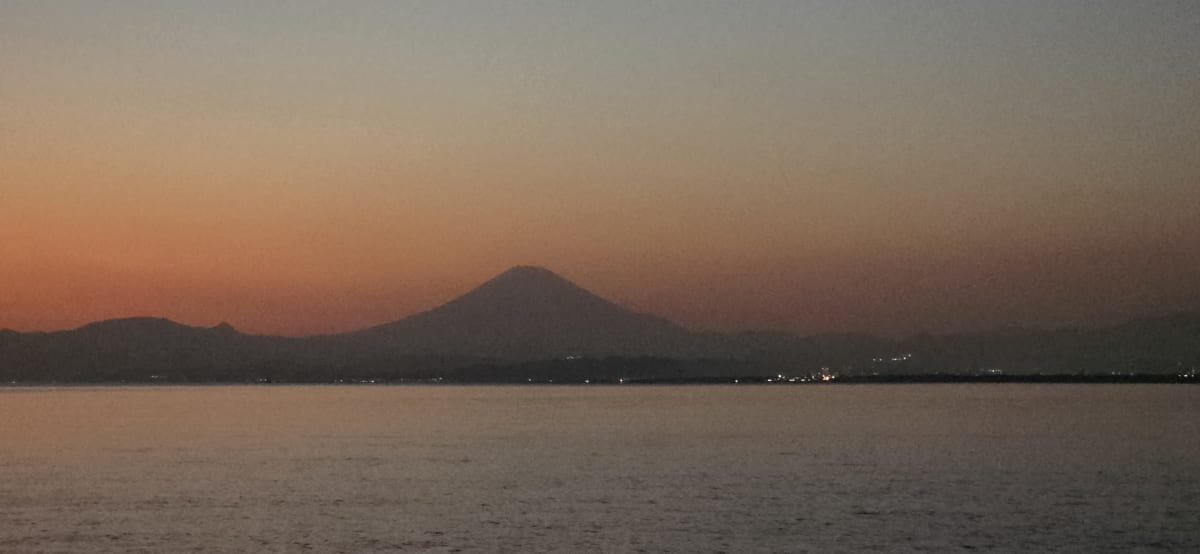
The west-facing side of the Sea Candle's deck is the reason most people come at this hour. Across Sagami Bay, on a clear day, Mount Fuji's silhouette sits exactly where the sun goes down. From November through February, the air is dry and the visibility is reliable: the Fuji silhouette is there nine evenings out of ten. Our January evening was textbook. Not a cloud in the sky, the mountain etched against an orange-to-pink gradient, and the sun dropping into the saddle of the southern slope at 4:43 on the dot. From May through August, summer haze hides Fuji more often than not, and the sunset is still pretty but Fuji-less. Plan accordingly.
Sunset times to check before you go: roughly 4:35 PM in December, 5:30 in March, 6:55 in June, 5:10 in October. Aim to be on the deck thirty minutes before the listed time, both for the gradient and to claim a spot at the railing.
If you stay after sunset, the garden runs a seasonal Enoshima Shonan no Hoseki illumination from late November through February. The Sea Candle is lit blue, and the path back down to the shore stays open until 8:00.
The Train Back to Yokohama
Two ways back, both legitimate.
The fast way (around 30 minutes, around ¥500). Walk back across Benten Bridge and over to Katase-Enoshima Station. Take the Odakyu Enoshima Line to Fujisawa (¥170, 7 minutes). Transfer to the JR Tokaido Line and ride 20 minutes to Yokohama (¥330). The JR leg is JR Pass covered; the Odakyu leg is not.
The scenic way (around 50 minutes, around ¥600). Walk back to Enoshima Station and ride the Enoden the full length back to Kamakura (¥310, 25 minutes). From Kamakura, take the JR Yokosuka Line to Yokohama (¥340, 25 minutes). You doubled your Enoden time, you got the night version of the coastal track, and your total cost only went up by about ¥150. The JR leg is JR Pass covered; the Enoden leg is not.
Most travellers will choose the fast way after a full day on their feet. Anyone who came here for the train ride should choose the scenic one. Either way, you are stepping off in Yokohama in time for dinner, with the option of ramen in Chinatown if you are not done eating.
The Numbers
Transit (fast return):
| Leg | Cost | Time | JR Pass? |
|---|---|---|---|
| Yokohama to Kamakura (JR Yokosuka) | ¥340 | 25 min | Yes |
| Bus or walk to Hokokuji | ¥200 / free | 15 to 25 min | No |
| Kamakura to Yuigahama (Enoden) | ¥200 | 4 min | No |
| Yuigahama to Hase (Enoden) | ¥200 | 3 min | No |
| Hase to Enoshima (Enoden) | ¥260 | 15 min | No |
| Odakyu + JR Tokaido back to Yokohama | ¥500 | 30 min | JR leg only |
| Transit total | ~¥1,650 | ~95 min on trains |
Stops:
| Stop | Cost | Time on site |
|---|---|---|
| Tsurugaoka Hachimangu | Free | 45 min |
| Hokokuji (with matcha) | ¥500 | 45 min |
| Yuigahama Beach | Free | 30 min |
| Kotoku-in / Great Buddha (inside) | ¥320 | 45 min |
| Enoshima Escar (one-way) | ¥360 | 10 min |
| Sea Candle + Garden combo | ¥800 | 1 hour |
| Two giant crackers (prawn + octopus) | ¥1,300 | included above |
| Stops total (excluding lunch) | ~¥3,280 |
Lunch was deliberately left flexible. A shirasu-don in Komachi-dori runs ¥1,000 to ¥1,500. Counter sushi in Hase is ¥2,000 to ¥4,000. A konbini onigiri eaten on Yuigahama Beach is ¥150. The food rundown on the Kamakura page is worth a scan if you want a specific recommendation, and the practical tips section covers ATMs, cash-only spots, and the things that catch first-timers off guard.
Do this whole loop on a clear Saturday in January and you come back to Yokohama with about 18,000 steps on your phone, cold hands, a depleted IC card balance, one good kite story to tell over ramen, and the certainty that you will do this loop again next time you are in town.