Osaka
Kuidaore city: Dotonbori's neon, Shinsekai's kushikatsu, and Japan's friendliest strangers
About Osaka
Here's the thing about Osaka: you'll eat better for less money than anywhere else in Japan. A full tray of takoyaki from a Dotonbori stand, a kushikatsu feast in the retro lanes of Shinsekai, a morning graze through Kuromon Market's seafood stalls. The city is built around the idea of kuidaore: eat until you drop. And unlike Tokyo, where everyone politely minds their business, someone in Osaka will probably strike up a conversation with you at the counter. The locals are famously friendly, and the food is the icebreaker.
Base yourself near Namba Station (where the Nankai, JR, and subway lines all converge) and you can walk to Dotonbori, Kuromon Market, and Shinsaibashi in under 15 minutes. Come spring, Osaka Castle Park erupts in cherry blossoms and the afternoon crowds thin by sunset. In July, Tenjin Matsuri lights up the river with fireworks and floating lanterns, one of Japan's greatest summer festivals. Winter is mild, quieter, and the food keeps you warm.
If you're short on time, Dotonbori after dark and Osaka Castle in the morning are the non-negotiables. Add Shinsekai for kushikatsu, Kuromon Market for seafood, and the Umeda Sky Building for the view, and you've got a solid two days. Kyoto is 30 minutes by JR rapid; Nara is 45 minutes; Kobe is 30 minutes by Hankyu. Osaka makes an excellent base for the whole Kansai region. And whatever you do, don't double-dip in the kushikatsu sauce. They mean it.
Osaka Districts
Explore Osaka's diverse neighborhoods, each with its own unique character
Dotonbori
Must-See2–3 hours (evening)
Osaka's most visited strip, where giant mechanical crabs and neon signs compete for attention above the canal. Come hungry and after dark for the full effect. Daytime is fine for takoyaki; the real spectacle starts at dusk.
Highlights:
Best For:
Shinsekai
Must-See2–3 hours
A retro neighborhood built in 1912 to resemble Paris and New York's Coney Island, now a slightly rough-edged food district famous for kushikatsu. Tsutenkaku Tower anchors the skyline; Janjan Yokocho alley has the best restaurants.
Highlights:
Best For:
Namba
Must-SeeHalf day to full day
The beating heart of Minami (south Osaka), where the subway, Nankai rail, and shopping streets all converge. Shinsaibashi-suji arcade connects north to Dotonbori; Hozenji Yokocho is the narrow moss-covered alley for a quieter drink.
Highlights:
Best For:
Umeda
Worth a DetourHalf day
Osaka's modern north district, anchored by Osaka Station and Hankyu Umeda. Cleaner and more polished than Namba, with the Umeda Sky Building's open-air observatory worth the trip north.
Highlights:
Best For:
Tennoji
If You're NearbyHalf day
South of Namba, anchored by Shitenno-ji (Japan's oldest officially administered temple) and Abeno Harukas (Japan's tallest building). More local, better value, and less touristy than the Dotonbori corridor.
Highlights:
Best For:
Amerikamura
If You're Nearby2–3 hours
Osaka's answer to Harajuku: a compact block of vintage shops, streetwear, and independent labels. More relaxed than Tokyo's version and easier to navigate. Triangle Park in the middle is the social hub.
Highlights:
Best For:
Top Attractions
Must-see landmarks, temples, and experiences in Osaka
Osaka Castle
The symbol of Osaka, rebuilt multiple times but still the most photogenic spot in the city. The main keep has a Toyotomi history museum inside (¥600), but most visitors are here for the park. In late March to early April, the outer moat's cherry blossom ring is one of Osaka's best free experiences. Arrive before 9am on weekdays to beat school groups.
Dotonbori
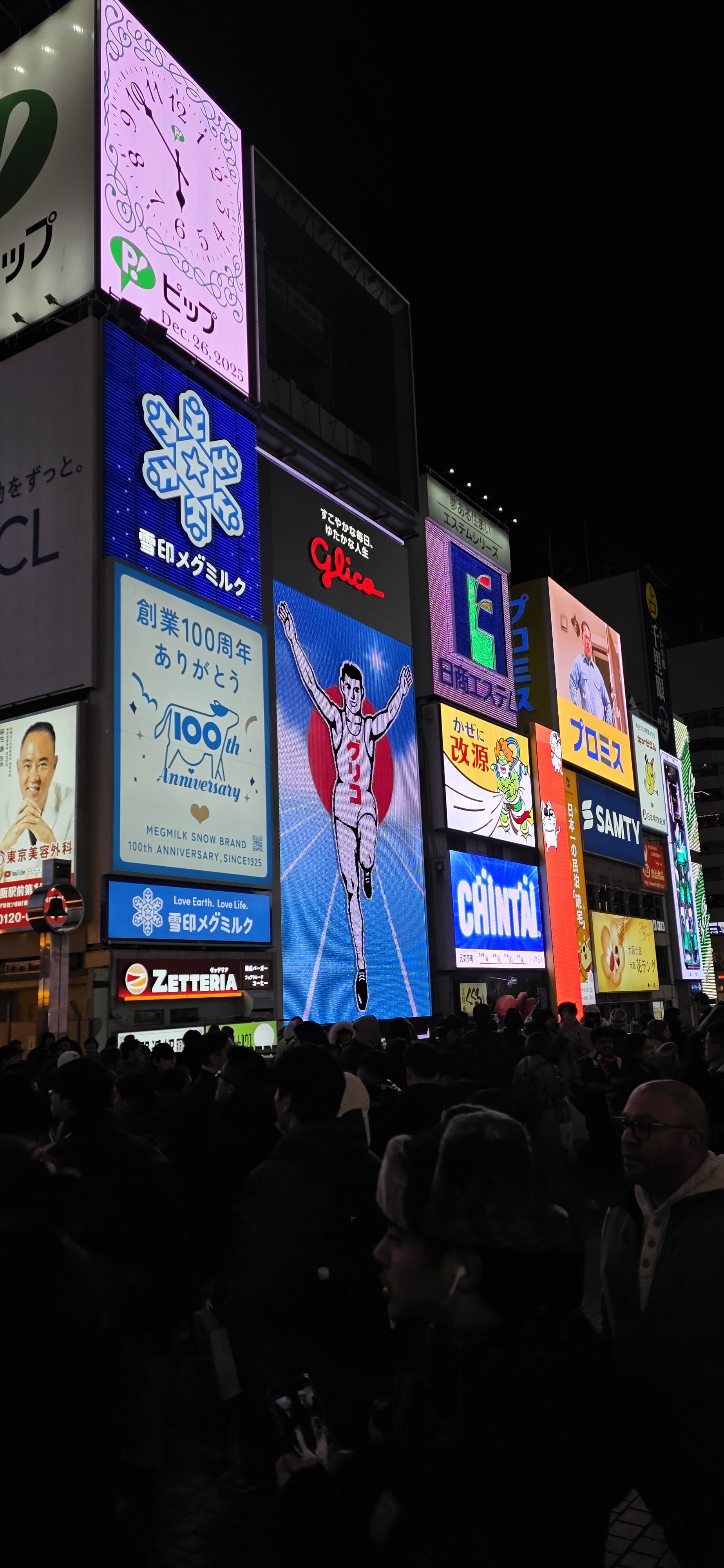
Osaka's most photographed strip. Come after dark, when the Glico Running Man sign and the mechanical Kani Doraku crab are fully lit above the canal. Takoyaki from a stand by the Glico sign is the entry-level experience; Hozenji Yokocho, a narrow moss-covered alley a short walk south, is where you go for a quieter drink. Come hungry.
Kuromon Ichiba Market
Osaka's kitchen since 1902: a 600-metre covered arcade of fishmongers, seafood stalls, and street food vendors. Come before 10am for the freshest tuna and sea urchin; after noon the best stock is gone. Most stalls serve eat-as-you-walk seafood. Budget ¥1,500–2,500 for a proper food crawl.
Tsutenkaku Tower and Shinsekai
The retro tower is the excuse to visit Shinsekai, not the main event. The observation deck (¥900 main floor, ¥1,500 top) gives a decent city view, but the real reason to come is the neighborhood below: post-war Japan in amber, with kushikatsu restaurants on every corner. Rub the Billiken statue's feet on the second floor for luck. Plan the visit around a Shinsekai kushikatsu lunch.
Osaka Aquarium Kaiyukan
One of Japan's best aquariums, built around a massive central Pacific Ocean tank that you spiral down around over 8 floors. The whale sharks are the centrepiece. Allow 2–3 hours; it fills fast on weekends and school holidays. The aquarium is in Tempozan, 15 minutes from Namba by subway (Osaka Metro Chuo Line to Osakako Station).
Universal Studios Japan
Japan's most visited theme park, and currently one of the world's best. Super Nintendo World (Mario Kart ride, Donkey Kong area) and the Wizarding World of Harry Potter are the draws. The Flying Dinosaur roller coaster has hour-long queues on weekends. Buy tickets in advance via Klook or the USJ site; Express Passes for Super Nintendo World sell out 2–4 weeks ahead. Arrive at gate opening (usually 8 or 9am) to get through Super Nintendo World before crowds hit.
Sumiyoshi Taisha
One of Japan's oldest shrines, with a distinctly Japanese architectural style that predates Chinese Buddhist influence. The famous arched Taiko-bashi bridge is steep enough that some visitors use the side steps instead of crossing the top. Genuinely quiet on weekday mornings. About 20 minutes south of Namba on the Nankai Line.
Shitenno-ji Temple
Japan's oldest officially administered temple, founded in 593 AD by Prince Shotoku. The main complex (¥300) has been rebuilt repeatedly but preserves the original straight-line layout from south gate through pagoda to main hall. Worth combining with a Tennoji neighborhood visit.
Namba Parks
A shopping complex with terraced rooftop gardens worth a look even if you don't shop. 9 floors of greenery built over the old Nankai Hawks Stadium site. Free to walk the rooftop canyon; shops open from 11am.
Where to Stay in Osaka
Osaka offers some of the best-value accommodation in Japan's major cities. The choice boils down to atmosphere vs convenience: Namba and Dotonbori puts you in the thick of the food and nightlife scene, Umeda is the polished business-district option with excellent transit links, and Tennoji offers the best rates with a more local feel. Shin-Osaka is the smart pick if you're using Osaka as a Shinkansen hub for day trips to Kyoto, Kobe, and Nara.
Best Areas to Stay
Namba and Dotonbori
Heart of the action: Dotonbori, Kuromon Market, and Shinsaibashi within a 15-minute walk. Noisy at night but unbeatable for food crawls and first-timers who want to walk everywhere.
Best for: Food lovers, nightlife, first-time visitors
Umeda and Shin-Osaka
Modern business district with excellent transit. Umeda Station connects JR, Hankyu, Hanshin, and Midosuji lines. Shin-Osaka (one stop north) is the Shinkansen station, ideal if you're day-tripping to Kyoto, Nara, or Kobe.
Best for: Day trippers, business travellers, transit convenience
Tennoji
South of the centre; JR Tennoji and Abeno Harukas anchor the area. Shitenno-ji Temple is a 10-minute walk. Quieter, more local, and the best value in the city.
Best for: Budget travellers, temple visitors, those who want a local feel without Dotonbori noise
Shinsaibashi
Between Namba and Dotonbori: same walkability, slightly less neon and noise. Shinsaibashi-suji shopping arcade runs through it. A good compromise if Dotonbori feels too intense.
Best for: Shopping-focused visitors, couples who want central location without all-night party noise
Near Universal Studios
Universal City Station (JR), 15–20 min from Namba. Only worth it if you're doing 2 or more days at USJ; otherwise you'll spend ¥400 and 45 minutes each way getting into the city.
Best for: Families doing multiple USJ days or those with early gate entry
Types of Accommodation
Business Hotels
Clean, efficient, small rooms. Great value and location. The standard for most visitors.
Capsule Hotels
A genuine Japanese experience, budget-friendly, and usually near stations.
Luxury Hotels
5-star service, premium locations, full facilities. Fewer options than Tokyo but the quality is there.
Hostels
Social atmosphere, budget-friendly, good for solo travellers.
Best Time to Visit
Spring (late March to May) and autumn (October to November) are the best times: comfortable temperatures, clear skies, and sakura or foliage as a bonus. Summer is hot and humid but Tenjin Matsuri in late July is worth the heat. Winter is mild, cheaper, and the food keeps you warm year-round.
Spring (March–May)
10–22°C (50–72°F)
Osaka Castle Park peaks for cherry blossoms in late March to early April. Comfortable temperatures for walking between food stops. Book accommodation well ahead for sakura week.
Pros:
- +Cherry blossoms at Osaka Castle Park
- +Comfortable walking weather
- +Ideal for food tours
Cons:
- -Sakura week is very crowded
- -Hotel prices spike in late March
- -Occasional rain
Summer (June–August)
23–33°C (73–91°F)
Hot and humid, but Tenjin Matsuri (late July) is one of Japan's three great festivals, with fireworks and processions on the river. Rainy season runs through June.
Pros:
- +Tenjin Matsuri fireworks (late July)
- +Long evenings for street food
- +Festive atmosphere
Cons:
- -Extreme heat and humidity
- -June rainy season
- -Uncomfortable for long outdoor walks
Autumn (September–November)
15–26°C (59–79°F)
Clear skies, cooling temperatures, and the food scene at its best. Typhoon season in September can disrupt travel; October onward is reliable.
Pros:
- +Perfect weather for walking
- +Clear skies
- +Fewer crowds than spring
Cons:
- -Typhoons possible in September
- -Peak season crowds at weekends
Winter (December–February)
5–12°C (41–54°F)
Mild compared to most of Japan. Fewer tourists, lower prices, and the street food circuit is as good as any time of year. Winter illuminations brighten the entertainment districts.
Pros:
- +Lowest prices and fewest crowds
- +Winter illuminations
- +Comfortable for eating your way around the city
Cons:
- -Cold evenings
- -Some outdoor attractions less appealing in rain
Osaka Food Scene
Osaka is Japan's kitchen. Kuidaore (eat until you drop) is the city's unofficial motto, and the food culture earns it: casual, generous, big portions, bold flavours, and a willingness to deep-fry just about anything. This is where street food became an art form, and where you'll eat some of the best meals of your trip without breaking the bank. Expect to spend ¥1,500–3,000 per meal at a sit-down place; ¥500–1,200 for a proper street food crawl.
Takoyaki
Osaka's signature snack: battered octopus balls cooked in special round iron pans, topped with sauce, mayo, bonito flakes, and seaweed. The inside should be gooey and molten. Wanaka near the Glico sign does a classic runny centre; Aizuya in Namba is crispier. Both around ¥500–600 for 8 pieces. The outside cools fast but the centre stays hot for 2 minutes. Blow on it first.
Where to try:
Okonomiyaki
Osaka-style savoury pancake: cabbage, meat, seafood, all mixed together and cooked on a hot plate in front of you. Osaka-style is mixed (not layered like Hiroshima-style). Mizuno in Dotonbori is the famous queue; Chitose in Shinsaibashi is less touristy with the same quality. Budget ¥1,000–1,500 for a filling meal.
Where to try:
Kushikatsu
Deep-fried skewers of meat, vegetables, and seafood, breaded and fried to order. Shinsekai is the heartland. Daruma on Janjan Yokocho is the institution with multiple branches; Yaekatsu does a slightly upscale version. ¥100–250 per skewer; a full meal runs ¥1,200–2,000. No double-dipping in the shared sauce. Seriously.
Where to try:
Kitsune Udon
Thick udon in a light dashi broth with sweet fried tofu (aburaage) on top. Osaka claims this dish as its own. Tsurutontan in Namba and Umeda does generous bowls for ¥800–1,200. Standing udon shops near Kuromon and in station basements do the classic version for ¥400–600. Look for the queue and the steam.
Where to try:
Horumon (Offal Yakiniku)
Grilled organ meats: heart, liver, intestine, cooked at the table on a charcoal grill. Osakans have strong opinions about where to get it. The back alleys off Dotonbori and the streets around Shinsekai have the best spots. Budget ¥2,000–3,500 for a full meal with beer.
Where to try:
Gyoza
Pan-fried dumplings, Osaka-style: thinner skin, crispier base. Gyoza no Ohsho is the reliable chain (6 for ¥350), found everywhere. Izakaya versions run ¥400–600. Good with a cold beer before the rest of the meal.
Where to try:
Suggested Itinerary
Day 1: Castle, Market, and Neon Lights
Day 2: Retro Vibes and City Views
Day 1: Castle, Market, and Neon Lights
Day 2: Shinsekai, Aquarium, and Umeda
Day 3: Kyoto Day Trip
Ready-Made Trip Plans Including Osaka
Jump-start your planning with a curated template
Nearby Day Trips

Kyoto
30 min by JR rapid from Osaka Station
Japan's ancient capital is 30 minutes by train and a world away in atmosphere. Fushimi Inari, Arashiyama, and the Gion district alone justify the trip. Go early; the major shrines fill up by 10am.

Nara
45 min by JR Yamatoji Line or Kintetsu from Namba
Japan's first permanent capital. The free-roaming deer of Nara Park are the main event, but Todai-ji's Great Buddha (¥800) is one of the country's genuine unmissables. Half a day is enough; easy to combine with Kyoto if you have a full day to spare.

Kobe
30 min by JR or Hankyu from Osaka Umeda
Japan's most international port city, with a relaxed vibe and the most famous beef in the country. A proper Kobe beef teppanyaki lunch runs ¥8,000–20,000; budget-friendlier options exist in the covered shopping arcades near the station. The Kitano-cho foreign residence district is worth a walk.
Himeji
1 hr by JR Shinkansen; 1 hr 20 min by JR Special Rapid
Himeji Castle is Japan's finest surviving original castle (UNESCO World Heritage Site), built in the early 1600s and never destroyed by war or fire. Unlike Osaka Castle, it's the real thing. The interior is open for self-guided exploration. Go on a weekday; cherry blossom season queues can run 90 minutes.
Practical Information
Getting to Osaka
From Tokyo
2 hr 30 min by Nozomi Shinkansen (¥14,720, reserved seat, not JR Pass covered); JR Pass holders take the Hikari (3 hr 10 min, same fare, JR Pass covered)
Kansai International Airport (KIX)
50 km southwest of central Osaka
Osaka International Airport (Itami / ITM)
15 km north of central Osaka
Daily Budget Guide
Hostels or capsule hotels, street food and convenience store meals, free attractions (Dotonbori, Kuromon Market, castle park)
Business hotels, mix of street food and sit-down restaurants, selected paid attractions
4–5 star hotels, kaiseki and Kobe beef meals, taxis, premium USJ Express Pass
Essential Osaka Tips
Buy an ICOCA card at any station on arrival (¥500 deposit; load ¥2,000–3,000 to start). It works on Osaka Metro, JR, Nankai, Hankyu, and Hanshin lines, plus convenience stores.
Dotonbori before 6pm is half the experience. The neon and the energy hit after dark; budget 7–10pm for the full spectacle.
Kushikatsu sauce rule: one dip per skewer, no double-dipping. Daruma in Shinsekai enforces it strictly. Other customers will tell you off too.
Stand on the RIGHT on escalators throughout Osaka. This is the opposite of Tokyo and Kyoto. Osakans will correct you if you block the left (walking) side.
Kuromon Market: arrive before 10am for the best tuna and sea urchin. After noon the freshest stock is gone and it's mostly tourist traffic.
USJ Express Pass for Super Nintendo World sells out 2–4 weeks ahead on busy dates. Book online via Klook or the USJ official site, not at the gate.
Takoyaki is molten inside for 2–3 minutes after serving even when the outside looks cool. Blow on it and bite the edge first.
Say 'okini' (oh-ki-ni) instead of 'arigatou'. It's Osaka dialect for thank you. Shopkeepers genuinely light up when foreigners use it.
Lunch rush is 11:30am–1:30pm and many sit-down restaurants close 2–5pm. Street food stalls stay open, but if you want a table, plan around those hours.
The Namba to Dotonbori to Shinsaibashi loop is one 20-minute walk. Skip the subway, save ¥180, and use Hozenji Yokocho (the moss-covered Buddha alley off Dotonbori) as your shortcut.
Osaka FAQ
Is Osaka worth visiting?
Yes, and not just as a Kyoto add-on. It is Japan's best street food city, its most outgoing big city, and its most convenient Kansai base, with Nara, Kobe, Himeji, and Kyoto all under an hour away. Hotels also run noticeably cheaper than Kyoto's, especially in peak seasons.
How many days do you need in Osaka?
Two days covers the city itself: Dotonbori and the Namba food streets, Osaka Castle, Shinsekai, and the Umeda Sky Building at sunset. Add a third for Universal Studios Japan or the Kaiyukan aquarium. Many travelers stay four or five nights and treat Osaka as a base for Kansai day trips.
How do I get from Kansai Airport into Osaka?
The Nankai Rapi:t reaches Namba in 35 minutes for 1,430 yen. If you are staying near Umeda or connecting to the Shinkansen at Shin-Osaka, the JR Haruka is the better ride at 3,200 to 3,500 yen. Both beat a taxi, which costs around 20,000 yen.
Does the JR Pass cover Tokyo to Osaka?
Only on the Hikari, which takes about 3 hours 10 minutes to Shin-Osaka. The faster Nozomi (2 hours 30 minutes, 14,720 yen) is excluded from the pass. Within Kansai, JR lines are covered as usual, including the 30-minute rapid train or 15-minute Shinkansen hop to Kyoto.
Where should I stay in Osaka?
Namba puts Dotonbori, Hozenji Yokocho, and the best eating streets at your door; it is the fun choice. Umeda is the business and transport hub with direct airport trains and the easiest day-trip connections. Pick Namba for nightlife, Umeda for logistics; nothing in central Osaka is more than 15 minutes from either.
What food is Osaka famous for?
Takoyaki, okonomiyaki, and kushikatsu (fried skewers with a strict no-double-dipping rule) are the big three, best eaten along Dotonbori or in Shinsekai. Kuromon Market covers the seafood mornings. The local word kuidaore, roughly 'eat yourself into ruin', is the city's actual food philosophy.
Book tours & activities in Osaka
Skip the line with pre-booked tickets and guided tours
via Klook · Affiliate link
Related Articles
Japan in October: Weather, Festivals and Where the Color Starts
Warm days, dry air, and the first mountain color. Weather by region, the 2026 foliage forecast, the big festivals, and October's booking traps.
Japan Travel Budget 2026: Real Daily Costs From $75 a Day
Is Japan expensive? Real 2026 daily budgets run ¥12,000 ($75) backpacking to ¥45,000 comfortable, with every price that builds those numbers.
How Many Days Do You Need in Japan? (2026 Guide)
Ten days is the sweet spot for a first trip, and seven works with the right route. Here's what each trip length realistically buys you.
Other Destinations
Tokyo
The world's greatest city: 14 million people, 200+ Michelin stars, and more to discover than any single trip can hold
Hiroshima
Peace Park, Miyajima's floating torii, and the best okonomiyaki in Japan: a city that turned tragedy into hope
Kyoto
A thousand years as Japan's capital: geisha in Gion, vermillion torii tunnels, and kaiseki cuisine elevated to art
Kamakura
Tokyo's favorite day trip: the Great Buddha since 1252, zen temples, hydrangeas at Hasedera, surf beaches, and shirasu-don an hour from the city
Yokohama
Japan's largest Chinatown, Cup Noodles Museum, and a waterfront that actually breathes (25 minutes from Tokyo)
Hakone
Two hours from Shinjuku: volcanic onsen, the Hakone Loop, and Mt. Fuji (when she shows up)
Nikko
Gold-leaf Toshogu, 97m Kegon Falls, and yuba soba: Japan's most opulent shrine town, 2 hours from Asakusa
Nara
1,200 bowing deer, the world's largest bronze Buddha, and temples that predate Kyoto, 45 minutes from Osaka
Kanazawa
Kyoto's calmer cousin: Kenroku-en at dawn, Omicho seafood, and 99% of Japan's gold leaf
Takayama
Preserved Edo streets, world-class Hida beef, and six sake breweries you can walk between in the Japanese Alps
Fukuoka
Yatai stalls at sunset, the best tonkotsu ramen in Japan by the Naka River, and all of Kyushu on your doorstep
Sapporo
Miso ramen at midnight, powder snow at Niseko, and a beer garden in Odori Park: Hokkaido's capital delivers
Nagoya
Miso katsu, golden shachihoko, and Toyota's textile-to-car story: the city everyone skips on the Shinkansen, and shouldn't
Kobe
Kobe beef that ruins all other steak, historic Kitano mansions, and Arima Onsen in the mountains
Nagasaki
Japan's only window to the outside world for 200 years: now champon, Dejima, and the Peace Park
Hakodate
One of the world's three best night views, a star-shaped fort, and the freshest kaisen-don in Japan at sunrise
Otaru
Gas-lit canals, port-fresh sushi, and Hokkaido's most romantic winter festival
Asahikawa
The zoo that redesigned how Japan thinks about animals, a ramen style with a pork-fat layer to beat the cold, and the gateway to Japan's largest national park
Sendai
Tohoku's capital: grilled beef tongue since 1948, Date Masamune's ornate mausoleum, and streamers across the sky every August
Aomori
Honshu's northern edge: Japan's most electrifying summer festival, world-class Jomon archaeology, and one of the last virgin beech forests on Earth
Morioka
Three completely distinct noodles, 1,000 cherry trees on a ruined castle, and Hiraizumi's Golden Hall 45 minutes south
Akita
Gravity-defying lantern poles at the Kanto Festival, Tohoku's finest samurai streets in Kakunodate, and sake from over thirty breweries
Yamagata
Yamadera's 1,015 steps, Ginzan Onsen's gaslit snow, sacred mountains, and Japan's best cherries
Fukushima
A blossom-covered mountain, a volcanic sky road, 200-yen Edo bathhouses, and Japan's best peaches, 90 minutes from Tokyo
Matsushima
One of Japan's three great views: 260 pine-clad islands, Date Masamune's Zen temple, and oysters grilled on the bay
Hirosaki
Japan's greatest cherry blossom castle, fan-shaped warrior floats at Neputa, and a city that produces one in five of Japan's apples
Aizuwakamatsu
A red-tiled castle, nineteen graves of teenage samurai, thatched Edo villages, and some of Japan's most decorated sake
Chiba
Narita-san Shinsho-ji, Tokyo DisneySea, and 100 km of Pacific coastline: most visitors see only the airport terminal
Saitama
Kawagoe's Edo warehouse street, Japan's first Shinkansen prototype, and the Chichibu Night Festival: Saitama earns a day
Mito
Japan's first flower season: Kairakuen's 3,000 plum trees six weeks before sakura, one of Japan's Three Great Gardens
Utsunomiya
Japan's gyoza capital: 200 shops, underground volcanic caverns at Oya, and Nikko 41 minutes by train
Maebashi
A free rose garden with 7,000 blooms, a volcanic caldera you can walk around, and the budget base for Kusatsu Onsen
Niigata
Japan's sake heartland: 90-plus breweries, Sea of Japan sushi at half the Tokyo price, and a ferry to Sado Island
Toyama
Base camp for the Tateyama snow walls, with white shrimp, firefly squid, and Sea of Japan sushi at half Tokyo prices
Fukui
Japan's dinosaur prefecture: a world-class museum, volcanic sea cliffs, the strictest Zen monastery, and Echizen crab in winter
Nagano
Zenko-ji pilgrims, snow monkeys in hot springs, and Hakuba powder: Japan's alpine heart
Shizuoka
Japan's tea capital: pine-framed Fuji views, the Tokugawa shrine that predates Nikko, and tiny pink shrimp found only in Suruga Bay
Gifu
Cormorant fishing by firelight, a mountain castle at sunset, and the gateway to Shirakawa-go's thatched villages
Kofu
Japan's wine capital: cellar tours a short walk from the station, hoto noodles, and the granite cliffs of Shosenkyo Gorge
Hakuba
Olympic powder, alpine hiking, and the most international mountain town in Japan
Matsumoto
Japan's oldest castle, alpine gateways, and a city that punches well above its size
Wakayama
Pilgrimage country: sleep in Koyasan's temples, walk the Kumano Kodo, and stand under Japan's tallest waterfall
Otsu
Kyoto's lakeside escape: Enryaku-ji's World Heritage halls, Japan's largest lake, and hotel rates Kyoto forgot, 10 minutes away
Tsu
Ise Jingu 50 minutes, Matsusaka wagyu 20 minutes: Tsu is the affordable base for the best of Mie Prefecture
Miyajima
A floating shrine gate, a 535-metre sacred mountain, and Hiroshima oysters grilled on the waterfront
Okayama
Korakuen garden, Crow Castle, Kurashiki canals, plus Naoshima art island 50 minutes away
Tottori
Japan's only coastal sand dunes, 50 meters high and 16km wide, where the desert meets the Sea of Japan
Matsue
One of Japan's five original castles, moat boats through samurai streets, and Lake Shinji sunsets, with mythical Izumo next door
Yamaguchi
Ruriko-ji's 1442 national treasure pagoda, Japan's largest limestone cave, and the gateway to Hagi and fugu country
Matsuyama
Japan's oldest hot spring, one of 12 original castles, and the gateway to the Shimanami Kaido cycling route
Takamatsu
Japan's udon capital, a Michelin three-star garden, and the ferry gateway to Naoshima's art islands
Tokushima
Japan's wildest dance festival, vine bridges over mountain gorges, and tidal whirlpools at the edge of Shikoku
Kochi
One of Japan's five original castles, a 300-year-old Sunday market, and katsuo no tataki seared over straw flames
Kumamoto
Japan's fiercest castle, garlic-laced ramen, and the world's largest active caldera: Kyushu's samurai heart
Beppu
Eight volcanic 'hells,' Takegawara sand baths, and Japan's densest onsen: steam rises from every corner
Kagoshima
Sakurajima erupting on the horizon, kurobuta pork on your plate, and Yakushima's 7,000-year-old cedars a ferry away
Miyazaki
Takachiho Gorge by rowboat, a shrine built into a sea cave, and chicken nanban from the city that invented it
Saga
The birthplace of Japanese porcelain, a hundred balloons over a river at dawn, and A5 wagyu at a fraction of Kobe prices
Oita
12th-century stone Buddhas in a cedar valley, toriten from its originator, and Beppu's steaming hells 28 minutes down the line
Naha
Shuri Castle, Kokusai-dori, and goya champuru: Japan's subtropical capital where Ryukyu royalty once ruled
Ishigaki
Kabira Bay emerald waters, world-class diving, and Japan's southernmost island gateway
Miyako Island
7km of turquoise sand, Ikema Bridge views, and Japan's clearest snorkeling
Ready to Explore Osaka?
Add Osaka as a stay in your trip and we'll help you find hotels and suggest activities