Japan Cherry Blossom Forecast 2027
When the cherry blossoms will open across Japan this spring: the Japan Meteorological Agency's official bloom declarations for all 47 prefectures, every forecast round, and live reports from 21 of the country's best sakura spots.
The first 2027 forecasts are due from mid December. Until then the map shows when each prefecture's official benchmark tree opened in the last six seasons, straight from the Japan Meteorological Agency's records.
Waiting for the First 2027 Forecast (Updated September 28)
The first 2027 forecasts are due from mid December. For the 2026 season, Japan Meteorological Corporation published first, on December 18, 2025, followed by Weathernews on January 8 and the Japan Weather Association on January 29. The map above moves onto the forecast dates the day round one lands.
Until then, the best guide is what the official trees actually did. In the last six springs, 206 of 282 prefectural first blooms came earlier than the official normal, and only 53 came later. The normals are 1991 to 2020 averages, and the gap is widest in the north: Sapporo opened between April 15 and 23 in every one of those years, against a normal of May 1.
If you are booking now, aim the Tokyo and Kyoto core of the trip at the last week of March and the first days of April, choose refundable rooms, and keep a day or two of slack. One season can move a lot: Tokyo's first bloom ranged from March 14 to March 29 between 2021 and 2026.
How the Sakura Front Moves
The season opens in Okinawa in January with hikanzakura, the deep-pink cherry JMA observes there in place of Somei Yoshino: Naha's tree opened between January 4 and 18 in the last six springs. The main event, Somei Yoshino, starts in mid to late March across a broad band from Kyushu and Shikoku to Tokai and Tokyo. The first official opening has come in Hiroshima, Fukuoka, Tokyo, Kochi, and Gifu in different recent years, so "south first" is only roughly true.
From there the front reaches Kansai within days, Hokuriku and southern Tohoku around the start of April, Aomori in mid April, and Hokkaido from around April 20. Eastern Hokkaido closes the season in early to mid May with ezoyamazakura. From the first Somei Yoshino opening to Sapporo's full bloom, the whole run took between 32 and 47 days in 2021 to 2026.
One planning detail matters here: full bloom follows first bloom by about a week in Tokyo, Kyoto, and Osaka (6 to 10 days in the last six springs), but only 2 to 7 days in Sendai, Aomori, and Sapporo. In the north, spring arrives in a rush, so a trip there needs tighter timing.
What First Bloom and Full Bloom Mean
Both are official declarations from one benchmark tree per city. First bloom (kaika) is the first day five or six flowers are open on that tree, and full bloom (mankai) is the first day about 80% of its buds are open. Tokyo's tree is a Somei Yoshino at Yasukuni Shrine, observed there since 1966, and Osaka's stands in Osaka Castle's Nishinomaru Garden. Where Somei Yoshino doesn't grow, JMA watches a local cherry instead: hikanzakura in Okinawa and Amami, ezoyamazakura in parts of Hokkaido. The agency stopped publishing forecasts in 2010, leaving those to private forecasters, but it still makes every declaration this map is built on.
Official Bloom Dates: The Last Six Springs
Every date below is the day the Japan Meteorological Agency declared first bloom and full bloom on its benchmark tree in each city. The last column gives JMA's official normal (the 1991 to 2020 average).
- NahaNormal Jan 16
- 2021
- Jan 4 · full bloom Feb 1
- 2022
- Jan 11 · full bloom Feb 1
- 2023
- Jan 7 · full bloom Jan 30
- 2024
- Jan 13 · full bloom Feb 5
- 2025
- Jan 5
- 2026
- Jan 18 · full bloom Feb 3
Median first bloom 7 days earlier than the official normal. - FukuokaNormal Mar 22
- 2021
- Mar 12 · full bloom Mar 22
- 2022
- Mar 17 · full bloom Mar 27
- 2023
- Mar 18 · full bloom Mar 26
- 2024
- Mar 27 · full bloom Apr 2
- 2025
- Mar 25 · full bloom Mar 28
- 2026
- Mar 24 · full bloom Apr 3
Median first bloom 1 day earlier than the official normal. - HiroshimaNormal Mar 25
- 2021
- Mar 11 · full bloom Mar 25
- 2022
- Mar 21 · full bloom Mar 29
- 2023
- Mar 19 · full bloom Mar 28
- 2024
- Mar 25 · full bloom Apr 5
- 2025
- Mar 26 · full bloom Apr 2
- 2026
- Mar 19 · full bloom Mar 30
Median first bloom 5 days earlier than the official normal. - KochiNormal Mar 22
- 2021
- Mar 15 · full bloom Mar 23
- 2022
- Mar 19 · full bloom Mar 27
- 2023
- Mar 17 · full bloom Mar 24
- 2024
- Mar 23 · full bloom Mar 31
- 2025
- Mar 23 · full bloom Mar 28
- 2026
- Mar 16 · full bloom Mar 31
Median first bloom 4 days earlier than the official normal. - OsakaNormal Mar 27
- 2021
- Mar 19 · full bloom Mar 28
- 2022
- Mar 23 · full bloom Mar 30
- 2023
- Mar 19 · full bloom Mar 27
- 2024
- Mar 30 · full bloom Apr 6
- 2025
- Mar 27 · full bloom Apr 4
- 2026
- Mar 26 · full bloom Apr 3
Median first bloom 2 days earlier than the official normal. - KyotoNormal Mar 26
- 2021
- Mar 16 · full bloom Mar 26
- 2022
- Mar 24 · full bloom Mar 30
- 2023
- Mar 17 · full bloom Mar 24
- 2024
- Mar 29 · full bloom Apr 5
- 2025
- Mar 27 · full bloom Apr 5
- 2026
- Mar 23 · full bloom Mar 30
Median first bloom 2 days earlier than the official normal. - NagoyaNormal Mar 24
- 2021
- Mar 17 · full bloom Mar 28
- 2022
- Mar 22 · full bloom Mar 30
- 2023
- Mar 17 · full bloom Mar 27
- 2024
- Mar 28 · full bloom Apr 7
- 2025
- Mar 26 · full bloom Apr 4
- 2026
- Mar 17 · full bloom Mar 30
Median first bloom 4 days earlier than the official normal. - TokyoNormal Mar 24
- 2021
- Mar 14 · full bloom Mar 22
- 2022
- Mar 20 · full bloom Mar 27
- 2023
- Mar 14 · full bloom Mar 22
- 2024
- Mar 29 · full bloom Apr 4
- 2025
- Mar 24 · full bloom Mar 30
- 2026
- Mar 19 · full bloom Mar 28
Median first bloom 4 days earlier than the official normal. - KanazawaNormal Apr 3
- 2021
- Mar 23 · full bloom Mar 29
- 2022
- Mar 30 · full bloom Apr 5
- 2023
- Mar 23 · full bloom Mar 30
- 2024
- Apr 1 · full bloom Apr 8
- 2025
- Mar 29 · full bloom Apr 6
- 2026
- Mar 29 · full bloom Apr 3
Median first bloom 5 days earlier than the official normal. - SendaiNormal Apr 8
- 2021
- Mar 28 · full bloom Mar 31
- 2022
- Apr 8 · full bloom Apr 11
- 2023
- Mar 26 · full bloom Mar 31
- 2024
- Apr 2 · full bloom Apr 9
- 2025
- Apr 4 · full bloom Apr 10
- 2026
- Mar 31 · full bloom Apr 4
Median first bloom 7 days earlier than the official normal. - AomoriNormal Apr 22
- 2021
- Apr 13 · full bloom Apr 17
- 2022
- Apr 16 · full bloom Apr 20
- 2023
- Apr 7 · full bloom Apr 11
- 2024
- Apr 15 · full bloom Apr 18
- 2025
- Apr 17 · full bloom Apr 22
- 2026
- Apr 13 · full bloom Apr 16
Median first bloom 8 days earlier than the official normal. - SapporoNormal May 1
- 2021
- Apr 22 · full bloom Apr 27
- 2022
- Apr 23 · full bloom Apr 25
- 2023
- Apr 15 · full bloom Apr 21
- 2024
- Apr 18 · full bloom Apr 24
- 2025
- Apr 23 · full bloom Apr 27
- 2026
- Apr 18 · full bloom Apr 24
Median first bloom 11 days earlier than the official normal.
| City | 2021 | 2022 | 2023 | 2024 | 2025 | 2026 | Normal |
|---|---|---|---|---|---|---|---|
| Naha hikanzakura | Jan 4 full Feb 1 | Jan 11 full Feb 1 | Jan 7 full Jan 30 | Jan 13 full Feb 5 | Jan 5 | Jan 18 full Feb 3 | Jan 16 full Feb 4 |
| Fukuoka | Mar 12 full Mar 22 | Mar 17 full Mar 27 | Mar 18 full Mar 26 | Mar 27 full Apr 2 | Mar 25 full Mar 28 | Mar 24 full Apr 3 | Mar 22 full Mar 31 |
| Hiroshima | Mar 11 full Mar 25 | Mar 21 full Mar 29 | Mar 19 full Mar 28 | Mar 25 full Apr 5 | Mar 26 full Apr 2 | Mar 19 full Mar 30 | Mar 25 full Apr 3 |
| Kochi | Mar 15 full Mar 23 | Mar 19 full Mar 27 | Mar 17 full Mar 24 | Mar 23 full Mar 31 | Mar 23 full Mar 28 | Mar 16 full Mar 31 | Mar 22 full Mar 30 |
| Osaka | Mar 19 full Mar 28 | Mar 23 full Mar 30 | Mar 19 full Mar 27 | Mar 30 full Apr 6 | Mar 27 full Apr 4 | Mar 26 full Apr 3 | Mar 27 full Apr 4 |
| Kyoto | Mar 16 full Mar 26 | Mar 24 full Mar 30 | Mar 17 full Mar 24 | Mar 29 full Apr 5 | Mar 27 full Apr 5 | Mar 23 full Mar 30 | Mar 26 full Apr 4 |
| Nagoya | Mar 17 full Mar 28 | Mar 22 full Mar 30 | Mar 17 full Mar 27 | Mar 28 full Apr 7 | Mar 26 full Apr 4 | Mar 17 full Mar 30 | Mar 24 full Apr 2 |
| Tokyo | Mar 14 full Mar 22 | Mar 20 full Mar 27 | Mar 14 full Mar 22 | Mar 29 full Apr 4 | Mar 24 full Mar 30 | Mar 19 full Mar 28 | Mar 24 full Mar 31 |
| Kanazawa | Mar 23 full Mar 29 | Mar 30 full Apr 5 | Mar 23 full Mar 30 | Apr 1 full Apr 8 | Mar 29 full Apr 6 | Mar 29 full Apr 3 | Apr 3 full Apr 8 |
| Sendai | Mar 28 full Mar 31 | Apr 8 full Apr 11 | Mar 26 full Mar 31 | Apr 2 full Apr 9 | Apr 4 full Apr 10 | Mar 31 full Apr 4 | Apr 8 full Apr 13 |
| Aomori | Apr 13 full Apr 17 | Apr 16 full Apr 20 | Apr 7 full Apr 11 | Apr 15 full Apr 18 | Apr 17 full Apr 22 | Apr 13 full Apr 16 | Apr 22 full Apr 26 |
| Sapporo | Apr 22 full Apr 27 | Apr 23 full Apr 25 | Apr 15 full Apr 21 | Apr 18 full Apr 24 | Apr 23 full Apr 27 | Apr 18 full Apr 24 | May 1 full May 6 |
All 58 JMA stations: normals, 2026 dates, and the six-spring median
| Station | Prefecture | Normal first bloom | 2026 first bloom | 2026 full bloom | Six-spring median |
|---|---|---|---|---|---|
| Naha (hikanzakura) | Okinawa | Jan 16 | Jan 18 | Feb 3 | Jan 9 |
| Miyakojima (hikanzakura) | Okinawa | Jan 17 | Jan 9 | Feb 6 | Jan 12 |
| Naze (Amami) (hikanzakura) | Kagoshima | Jan 20 | Feb 1 | – | Jan 21 |
| Ishigakijima (hikanzakura) | Okinawa | Jan 18 | Feb 4 | Feb 18 | Jan 27 |
| Minamidaitojima (hikanzakura) | Okinawa | Jan 20 | Mar 2 | – | Feb 16 |
| Kochi | Kochi | Mar 22 | Mar 16 | Mar 31 | Mar 18 |
| Gifu | Gifu | Mar 25 | Mar 16 | Mar 26 | Mar 19 |
| Tokyo | Tokyo | Mar 24 | Mar 19 | Mar 28 | Mar 20 |
| Kofu | Yamanashi | Mar 25 | Mar 16 | Mar 24 | Mar 20 |
| Nagoya | Aichi | Mar 24 | Mar 17 | Mar 30 | Mar 20 |
| Hiroshima | Hiroshima | Mar 25 | Mar 19 | Mar 30 | Mar 20 |
| Shizuoka | Shizuoka | Mar 24 | Mar 20 | Apr 2 | Mar 21 |
| Fukuoka | Fukuoka | Mar 22 | Mar 24 | Apr 3 | Mar 21 |
| Yokohama | Kanagawa | Mar 25 | Mar 22 | Apr 1 | Mar 22 |
| Saga | Saga | Mar 24 | Mar 21 | Apr 3 | Mar 22 |
| Miyazaki | Miyazaki | Mar 23 | Mar 24 | Apr 3 | Mar 22 |
| Matsuyama | Ehime | Mar 24 | Mar 24 | Apr 4 | Mar 23 |
| Nagasaki | Nagasaki | Mar 23 | Mar 27 | Apr 3 | Mar 23 |
| Kumamoto | Kumamoto | Mar 22 | Mar 23 | Apr 2 | Mar 23 |
| Kumagaya | Saitama | Mar 27 | Mar 23 | Apr 3 | Mar 24 |
| Kyoto | Kyoto | Mar 26 | Mar 23 | Mar 30 | Mar 24 |
| Wakayama | Wakayama | Mar 24 | Mar 24 | Apr 2 | Mar 24 |
| Oita | Oita | Mar 24 | Mar 24 | Apr 5 | Mar 24 |
| Kagoshima | Kagoshima | Mar 26 | Mar 27 | Apr 5 | Mar 24 |
| Maebashi | Gunma | Mar 29 | Mar 22 | Apr 1 | Mar 25 |
| Tsu | Mie | Mar 29 | Mar 24 | Mar 29 | Mar 25 |
| Osaka | Osaka | Mar 27 | Mar 26 | Apr 3 | Mar 25 |
| Nara | Nara | Mar 28 | Mar 24 | Mar 31 | Mar 25 |
| Shimonoseki | Yamaguchi | Mar 26 | Mar 24 | Apr 6 | Mar 25 |
| Takamatsu | Kagawa | Mar 27 | Mar 25 | Apr 1 | Mar 25 |
| Mito | Ibaraki | Mar 30 | Mar 25 | Apr 3 | Mar 26 |
| Utsunomiya | Tochigi | Mar 30 | Mar 24 | Apr 3 | Mar 26 |
| Choshi | Chiba | Mar 30 | Mar 25 | Apr 3 | Mar 26 |
| Kobe | Hyogo | Mar 27 | Mar 27 | Apr 5 | Mar 26 |
| Okayama | Okayama | Mar 28 | Mar 25 | Mar 31 | Mar 26 |
| Tokushima | Tokushima | Mar 28 | Mar 28 | Apr 6 | Mar 26 |
| Tottori | Tottori | Mar 29 | Mar 28 | Mar 31 | Mar 27 |
| Matsue | Shimane | Mar 29 | Mar 27 | Mar 31 | Mar 27 |
| Kanazawa | Ishikawa | Apr 3 | Mar 29 | Apr 3 | Mar 29 |
| Fukui | Fukui | Apr 1 | Mar 29 | Mar 31 | Mar 30 |
| Hikone | Shiga | Apr 1 | Mar 29 | Apr 2 | Mar 30 |
| Toyama | Toyama | Apr 3 | Mar 29 | Apr 2 | Mar 31 |
| Sendai | Miyagi | Apr 8 | Mar 31 | Apr 4 | Apr 1 |
| Fukushima | Fukushima | Apr 7 | Mar 29 | Apr 3 | Apr 1 |
| Niigata | Niigata | Apr 8 | Mar 31 | Apr 3 | Apr 3 |
| Nagano | Nagano | Apr 11 | Mar 31 | Apr 6 | Apr 4 |
| Yamagata | Yamagata | Apr 13 | Apr 2 | Apr 6 | Apr 5 |
| Akita | Akita | Apr 17 | Apr 6 | Apr 9 | Apr 8 |
| Morioka | Iwate | Apr 18 | Apr 7 | Apr 12 | Apr 11 |
| Aomori | Aomori | Apr 22 | Apr 13 | Apr 16 | Apr 14 |
| Hakodate | Hokkaido | Apr 28 | Apr 18 | Apr 20 | Apr 19 |
| Sapporo | Hokkaido | May 1 | Apr 18 | Apr 24 | Apr 20 |
| Obihiro (ezoyamazakura) | Hokkaido | May 2 | Apr 18 | Apr 22 | Apr 23 |
| Asahikawa (ezoyamazakura) | Hokkaido | May 4 | Apr 21 | Apr 26 | Apr 26 |
| Muroran | Hokkaido | May 4 | Apr 23 | Apr 28 | Apr 26 |
| Abashiri (ezoyamazakura) | Hokkaido | May 10 | May 3 | May 7 | May 1 |
| Wakkanai (ezoyamazakura) | Hokkaido | May 13 | May 1 | May 6 | May 5 |
| Kushiro (ezoyamazakura) | Hokkaido | May 16 | May 3 | May 6 | May 5 |
The 2027 Season at a Glance
January & February: Okinawa and Izu
- Deep-pink hikanzakura on castle walls and hillsides: Japan's first cherry blossoms of the year.
- Usually best
- Late January to mid February
- 2027 forecast
- Due from mid December
- Kawazu (Izu)BudsAbout 850 early-blooming Kawazu-zakura along the Kawazu River in Izu, with a month-long festival.
- Usually best
- Early February to early March
- 2027 forecast
- Due from mid December
| Spot | Usually best | 2027 forecast | Status |
|---|---|---|---|
| Okinawa (Nago, Motobu, Nakijin) Deep-pink hikanzakura on castle walls and hillsides: Japan's first cherry blossoms of the year. | Late January to mid February | Due from mid December | Buds |
| Kawazu (Izu) About 850 early-blooming Kawazu-zakura along the Kawazu River in Izu, with a month-long festival. | Early February to early March | Due from mid December | Buds |
Kyushu
- FukuokaBudsAbout 1,000 trees in the Fukuoka Castle ruins, lit up at night, and Nishi Park's 1,300 above Hakata Bay.
- Usually best
- Late March to early April
- 2027 forecast
- Due from mid December
- Kumamoto CastleBudsKato Kiyomasa's castle, still under earthquake restoration, framed by cherries.
- Usually best
- Late March to early April
- 2027 forecast
- Due from mid December
| Spot | Usually best | 2027 forecast | Status |
|---|---|---|---|
| Fukuoka About 1,000 trees in the Fukuoka Castle ruins, lit up at night, and Nishi Park's 1,300 above Hakata Bay. | Late March to early April | Due from mid December | Buds |
| Kumamoto Castle Kato Kiyomasa's castle, still under earthquake restoration, framed by cherries. | Late March to early April | Due from mid December | Buds |
Chugoku
- Cherries along the rivers of the Peace Memorial Park, Shukkeien's light-up, and Miyajima's shrine grounds.
- Usually best
- Late March to early April
- 2027 forecast
- Due from mid December
| Spot | Usually best | 2027 forecast | Status |
|---|---|---|---|
| Hiroshima & Miyajima Cherries along the rivers of the Peace Memorial Park, Shukkeien's light-up, and Miyajima's shrine grounds. | Late March to early April | Due from mid December | Buds |
Kansai
- Himeji CastleBudsThe white castle above a sea of cherries, with a paid night-sakura garden.
- Usually best
- Late March to early April
- 2027 forecast
- Due from mid December
- OsakaBudsAbout 3,000 trees at Osaka Castle, 4,500 along the Okawa, and the Mint's reservation-only cherry passage.
- Usually best
- Late March to early April; the Mint passage early to mid April
- 2027 forecast
- Due from mid December
- KyotoBudsMaruyama Park's lit weeping cherry, the Philosopher's Path, Arashiyama, and Daigo-ji's relay of varieties.
- Usually best
- Late March to mid April, by site
- 2027 forecast
- Due from mid December
- Nara Park's cherries among the deer, and Mt Yoshino's white mountain cherries climbing in four zones.
- Usually best
- Nara late March to early April; Yoshino through April
- 2027 forecast
- Due from mid December
| Spot | Usually best | 2027 forecast | Status |
|---|---|---|---|
| Himeji Castle The white castle above a sea of cherries, with a paid night-sakura garden. | Late March to early April | Due from mid December | Buds |
| Osaka About 3,000 trees at Osaka Castle, 4,500 along the Okawa, and the Mint's reservation-only cherry passage. | Late March to early April; the Mint passage early to mid April | Due from mid December | Buds |
| Kyoto Maruyama Park's lit weeping cherry, the Philosopher's Path, Arashiyama, and Daigo-ji's relay of varieties. | Late March to mid April, by site | Due from mid December | Buds |
| Nara & Mt Yoshino Nara Park's cherries among the deer, and Mt Yoshino's white mountain cherries climbing in four zones. | Nara late March to early April; Yoshino through April | Due from mid December | Buds |
Chubu
- NagoyaBudsAbout 900 trees at Nagoya Castle with evening light-ups, and the Yamazaki River's cherry avenue.
- Usually best
- Late March to early April
- 2027 forecast
- Due from mid December
- Fuji Five LakesBudsThe Chureito Pagoda view of cherries and Mt Fuji, and the Lake Kawaguchi north shore.
- Usually best
- Early to mid April, sometimes later
- 2027 forecast
- Due from mid December
- KanazawaBudsKenroku-en, free and open until 21:30 for about a week at peak, next to the always-free Kanazawa Castle Park.
- Usually best
- Early to mid April
- 2027 forecast
- Due from mid December
- TakayamaBudsCherries on the Miyagawa River by the red Nakabashi bridge, from mid April, three weeks after the lowlands.
- Usually best
- Mid to late April
- 2027 forecast
- Due from mid December
- Matsumoto Castle's moat lit at night, and Takato's pink kohigan-zakura, 'the finest cherries under heaven'.
- Usually best
- Early to mid April
- 2027 forecast
- Due from mid December
| Spot | Usually best | 2027 forecast | Status |
|---|---|---|---|
| Nagoya About 900 trees at Nagoya Castle with evening light-ups, and the Yamazaki River's cherry avenue. | Late March to early April | Due from mid December | Buds |
| Fuji Five Lakes The Chureito Pagoda view of cherries and Mt Fuji, and the Lake Kawaguchi north shore. | Early to mid April, sometimes later | Due from mid December | Buds |
| Kanazawa Kenroku-en, free and open until 21:30 for about a week at peak, next to the always-free Kanazawa Castle Park. | Early to mid April | Due from mid December | Buds |
| Takayama Cherries on the Miyagawa River by the red Nakabashi bridge, from mid April, three weeks after the lowlands. | Mid to late April | Due from mid December | Buds |
| Matsumoto & Takato Matsumoto Castle's moat lit at night, and Takato's pink kohigan-zakura, 'the finest cherries under heaven'. | Early to mid April | Due from mid December | Buds |
Kanto
- TokyoBudsUeno Park's lanterns, Chidorigafuchi's moat boats, the Meguro River, and Shinjuku Gyoen's 900 trees.
- Usually best
- Late March to early April
- 2027 forecast
- Due from mid December
| Spot | Usually best | 2027 forecast | Status |
|---|---|---|---|
| Tokyo Ueno Park's lanterns, Chidorigafuchi's moat boats, the Meguro River, and Shinjuku Gyoen's 900 trees. | Late March to early April | Due from mid December | Buds |
Tohoku
- About 8 km of cherries on the Shiroishi River with the Zao mountains behind, plus Sendai's city parks.
- Usually best
- Early to mid April
- 2027 forecast
- Due from mid December
- The thousand-year-old Miharu Takizakura, one of Japan's Three Great Cherry Trees, and Tsuruga Castle's 1,000 cherries.
- Usually best
- Miharu early to mid April; Aizu a little later
- 2027 forecast
- Due from mid December
- KakunodateBudsAbout 400 weeping cherries in the samurai district, then 2 km of Somei Yoshino on the Hinokinai River.
- Usually best
- Mid April to early May
- 2027 forecast
- Due from mid December
- Hirosaki CastleBudsAbout 2,600 cherries of 52 kinds around Hirosaki Castle's moats, home of the Hirosaki Cherry Blossom Festival.
- Usually best
- Mid April to early May
- 2027 forecast
- Due from mid December
| Spot | Usually best | 2027 forecast | Status |
|---|---|---|---|
| Sendai & the Shiroishi River About 8 km of cherries on the Shiroishi River with the Zao mountains behind, plus Sendai's city parks. | Early to mid April | Due from mid December | Buds |
| Aizu & Miharu Takizakura The thousand-year-old Miharu Takizakura, one of Japan's Three Great Cherry Trees, and Tsuruga Castle's 1,000 cherries. | Miharu early to mid April; Aizu a little later | Due from mid December | Buds |
| Kakunodate About 400 weeping cherries in the samurai district, then 2 km of Somei Yoshino on the Hinokinai River. | Mid April to early May | Due from mid December | Buds |
| Hirosaki Castle About 2,600 cherries of 52 kinds around Hirosaki Castle's moats, home of the Hirosaki Cherry Blossom Festival. | Mid April to early May | Due from mid December | Buds |
Hokkaido
- Goryokaku's star-shaped fort outlined in about 1,500 cherries, and Matsumae's 10,000 trees of some 250 varieties.
- Usually best
- Late April to mid May
- 2027 forecast
- Due from mid December
- SapporoBudsMaruyama Park's Ezo-yamazakura beside Hokkaido Shrine, and Moerenuma's 1,600-tree Sakura Forest.
- Usually best
- Late April to early May
- 2027 forecast
- Due from mid December
| Spot | Usually best | 2027 forecast | Status |
|---|---|---|---|
| Hakodate & Matsumae Goryokaku's star-shaped fort outlined in about 1,500 cherries, and Matsumae's 10,000 trees of some 250 varieties. | Late April to mid May | Due from mid December | Buds |
| Sapporo Maruyama Park's Ezo-yamazakura beside Hokkaido Shrine, and Moerenuma's 1,600-tree Sakura Forest. | Late April to early May | Due from mid December | Buds |
"Usually best" windows come from each spot's forecaster or official page. Until the first 2027 forecast lands, they are the right planning baseline; the six-spring table above shows how far a single season can move.
Spot-by-Spot Cherry Blossom Forecasts for 2027
Okinawa Cherry Blossoms 2027: Late January to Mid February
Okinawa opens Japan's cherry season in January: JMA's benchmark tree in Naha opened between January 4 and 18 in the last six springs, and the Nago tourism association puts the deep-pink blossoms at their best from late January to mid February. This is hikanzakura, a different cherry from the Somei Yoshino of Tokyo and Kyoto. The three big festivals are all in the north of the main island: Motobu's Mt Yaedake festival (January 17 to February 8 in 2026, extended a week for the bloom), the Nago Sakura Festival over one weekend (January 31 to February 1 in 2026), and the Nakijin Gusuku festival, when the World Heritage castle walls are lit at night (January 31 to February 8 in 2026). Nakijin Castle's entry is now 1,000 yen for adults. Naha guide →
Kawazu Cherry Blossoms 2027: February Sakura in Izu
Kawazu's cherries peak in February, about a month before Tokyo's: the town's tourism association gives early February to early March as the bloom season, and the festival's official 'best viewing' declaration came between February 12 and 28 over the last five festivals (February 13 in 2026). Kawazu-zakura is its own early-blooming variety, found in the town around 1955, and about 850 trees line the Kawazu River from the station toward Mine Onsen. The festival runs a full month (February 7 to March 8 in 2026) with the riverside lit from 18:00 to 21:00. The Odoriko limited express runs direct from Tokyo Station in about 2 hours 40 minutes, which beats the roads: the organisers warn of heavy traffic at peak, weekdays included.
Fukuoka Cherry Blossom Forecast 2027
Expect Fukuoka's cherries at their best from late March into early April: the city's official tree opened between March 12 and 27 in the last six springs, and the Japan Weather Association rates both main parks late March to early April. Maizuru Park, the Fukuoka Castle ruins, holds about 1,000 trees and the Fukuoka Castle Sakura Festival, with paid evening light-ups in three areas (600 yen each or 1,500 yen for all three, 18:00 to 22:00 in 2026); the park itself is free, about 8 minutes on foot from Ohorikoen subway station. Nishi Park, on a hill above Hakata Bay, has about 1,300 trees and restricts traffic in hanami season. Fukuoka guide →
Kumamoto Castle Cherry Blossoms 2027
Kumamoto Castle's cherries usually peak from late March to early April, the window both the Japan Weather Association and Weathernews give, and the city's official tree opened between March 17 and 26 in the last six springs. Entry is 800 yen for adults (web e-tickets available), and visits follow the special access route through the ongoing restoration. Check the castle's news page before you go: after the earthquake of July 28, 2026, the castle reopened, though some facilities around it, such as the Wakuwaku-za museum, were still closed in September. Kumamoto guide →
Hiroshima Cherry Blossom Forecast 2027
Hiroshima's cherries usually peak from late March to early April: the city's official tree opened between March 11 and 26 in the last six springs, and the Japan Weather Association rates both the Peace Memorial Park and Miyajima late March to early April (Weathernews leans a little later, early April). The Peace Park's Somei Yoshino line the rivers around the A-Bomb Dome and cost nothing to see. Shukkeien, the Edo-period garden next to the prefectural art museum, holds a sakura festival with an evening light-up (March 27 to April 5 in 2026); its entry rose to 350 yen in 2025. Hiroshima guide →
Himeji Castle Cherry Blossoms 2027
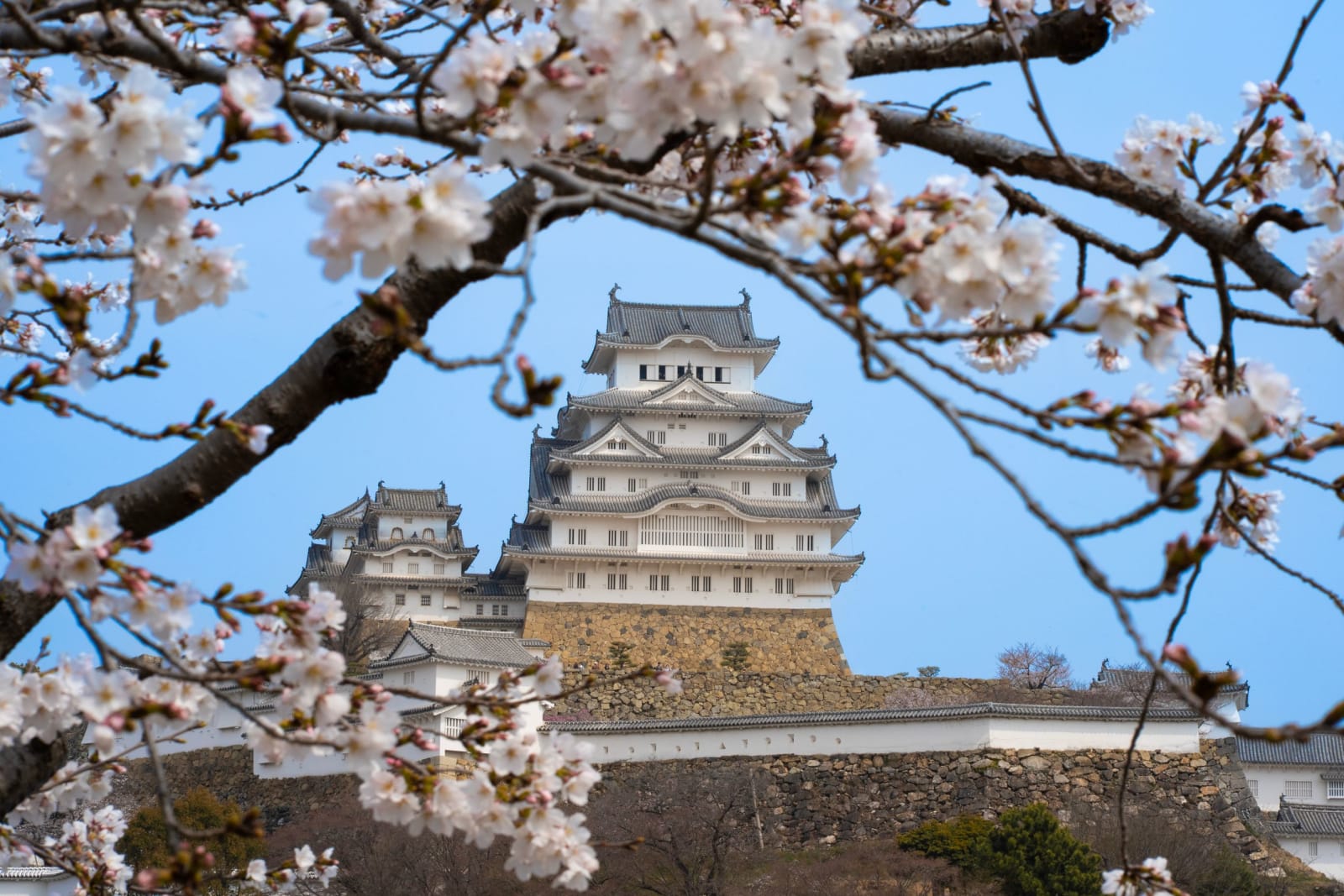
Himeji Castle's cherries usually peak from late March to early April, the window both the Japan Weather Association and Weathernews give. The castle is one of Japan's Top 100 Cherry Blossom Spots, and in 2026 its Nishinomaru Garden opened for a night sakura event (March 27 to April 5, 18:30 to 21:00, 600 yen, no booking needed). Budget for the new admission: since 2026 the castle costs 2,500 yen for adults who are not Himeji residents. The keep is lit every night from sunset to midnight, and the Sannomaru Square lawn in front of it needs no ticket at all. Himeji guide →
Osaka Cherry Blossom Forecast 2027
Osaka's cherries usually peak from late March to early April, and here you can visit the official tree itself: JMA's benchmark Somei Yoshino stands in Osaka Castle's Nishinomaru Garden, and it opened between March 19 and 30 in the last six springs. The castle park has about 3,000 cherry trees; the Nishinomaru Garden (350 yen during the 2026 night opening) stays open until 21:00 with the keep lit, and on the day JMA declares Osaka's bloom the keep turns sakura-pink until midnight. The Kema Sakuranomiya riverside adds about 4,500 trees for free. The Japan Mint's cherry passage follows a week or two later with late double-flowered varieties (April 9 to 15 in 2026) and has needed an advance booking every year since 2022; bookings opened on March 18 in 2026. Osaka guide →
Kyoto Cherry Blossom Forecast 2027
Kyoto's cherries peak from the last days of March into early April, site by site: the Japan Weather Association rates Maruyama Park, Arashiyama, and Daigo-ji late March to early April, the Heian Shrine garden late March to mid April, and the Philosopher's Path a little later, early to mid April. The city's official tree opened between March 16 and 29 in the last six springs. Maruyama Park's great weeping cherry is lit at night (18:00 to 22:00, March 24 to April 8 in 2026). Daigo-ji charges 1,800 yen for its three-site spring ticket, and it cancelled its Hotaiko Hanami Procession in 2026, so check before planning around it. Heian Shrine's garden, known for its red weeping cherries, costs 600 yen. Kyoto guide →
Nara and Yoshino Cherry Blossom Forecast 2027
Nara Park's Somei Yoshino peak from late March to early April (Nara's official tree opened between March 20 and 31 in the last six springs), and Mt Yoshino follows through April, climbing the mountain zone by zone: in 2026 the lower Shimo Senbon reached full bloom on April 1, Naka Senbon on April 2, Kami Senbon on April 4, and Oku Senbon on April 9. Yoshino's trees are mostly white mountain cherries rather than Somei Yoshino, and the mountain is part of a World Heritage site. Private cars cannot reserve parking and may be stopped from entering when roads jam, so take the Kintetsu train to Yoshino Station and the ropeway or the seasonal bus up (500 yen in 2026). Light-ups run at Shimo and Kami Senbon from 18:00 to 22:00 in season. Nara guide →
Nagoya Cherry Blossom Forecast 2027
Nagoya's cherries usually peak from late March to early April: its official tree opened between March 17 and 28 in the last six springs, and in 2023 and 2026 it was among the first in Japan to open (on March 17 in 2026, a week ahead of its normal). Nagoya Castle's roughly 900 trees are lit up during the spring festival, when the castle stays open until 19:30 (March 20 to April 5 in 2026; admission 500 yen). The Yamazaki River's Shiki-no-Michi walk and Tsuruma Park are free. Nagoya guide →
Mt Fuji Cherry Blossom Forecast 2027 (Chureito Pagoda and Kawaguchiko)
The Fuji Five Lakes bloom one to three weeks after the valley below: at about 800 m, Fujiyoshida City's bloom records show peak viewing ranging from early to late April in recent springs, and the Japan Weather Association rates Lake Kawaguchi's north shore early to late April. The famous view is from the Chureito Pagoda observation deck in Arakurayama Sengen Park, about 10 minutes' walk from Shimoyoshida Station. Fujiyoshida City dropped its sakura festival in 2026 because of overtourism, but crowd controls still ran: no vehicle access near the park, a timed rotation on the observation deck with 1 to 3 hour waits, and a request to stay out of residential streets. Lake Kawaguchi's free Fuji-Kawaguchiko Sakura Festival lights the north-shore trees until 21:00 (March 28 to April 15 in 2026). Tokyo day trips →
Kanazawa Cherry Blossom Forecast 2027 (Kenroku-en)
Kanazawa's cherries peak in early April: the city's official tree opened between March 23 and April 1 in the last six springs, earlier than its April 3 normal every time, and the Japan Weather Association rates Kenroku-en early to mid April. The best news is the price: for about a week at peak, Kenroku-en opens free from 7:00 to 21:30 with an evening light-up, and Kanazawa Castle Park stays open into the evening too (April 2 to 8 in 2026). Outside that week the garden costs 320 yen. The free week is announced right after JMA declares Kanazawa's first bloom, usually in the second half of March. Kanazawa guide →
Takayama Cherry Blossom Forecast 2027
Takayama blooms about three weeks after the lowlands: both the Japan Weather Association and Weathernews rate the Nakabashi bridge area and Miyagawa Ryokuchi Park mid to late April, when much of central Japan is already in leaf. The Spring Takayama Festival is fixed on April 14 and 15 every year (in 2027, a Wednesday and Thursday), with 12 festival floats on display, karakuri puppet shows, and a night festival on the 14th; central Takayama closes to cars, with shuttle buses from the Takumigaoka car park. The festival falls at the very start of the usual bloom window, so check the Takayama forecast before counting on floats and flowers together. Takayama guide →
Matsumoto Castle and Takato Cherry Blossoms 2027
Both usually peak in early to mid April, the Japan Weather Association's window for Matsumoto Castle and Takato Castle Ruins Park alike, and Takato can open surprisingly early: in 2026 it declared first bloom on March 28, three days before Nagano city's official tree, because its own variety, Takato kohigan-zakura, blooms early for its altitude. Takato charges during the bloom: 600 yen for adults, raised to 1,000 yen on the peak weekend in 2026, with a light-up from 18:00 to 21:00. Matsumoto Castle holds its Yozakura-kai night viewing for eight days, starting three days after the castle's own bloom declaration, with the Honmaru garden free at night; daytime entry to the keep is now 1,200 yen with an e-ticket. Matsumoto guide →
Tokyo Cherry Blossom Forecast 2027
Tokyo's cherries usually peak in the last week of March: the official tree at Yasukuni Shrine opened between March 14 and 29 in the last six springs and reached full bloom between March 22 and April 4, and the Japan Weather Association rates Ueno, the Meguro River, and Sumida Park late March to early April. Chidorigafuchi, a few minutes' walk from that tree, lines about 700 m of the Imperial Palace moat and is lit at night (March 26 to April 6 in 2026); guaranteed rowing-boat tickets cost 12,000 yen per boat per hour. Shinjuku Gyoen (500 yen) has about 900 trees of some 70 varieties that bloom from February to late April, and warns that sakura-season weekends may need advance reservations. Ueno Park hangs lanterns along Shinobazu Pond for the Ueno Sakura Matsuri (March 14 to April 5 in 2026), and the Meguro River has about 800 trees along 3.8 km of its banks. Tokyo guide →
Sendai and Shiroishi River Cherry Blossoms 2027 (Hitome Senbon Zakura)
The Shiroishi River's Hitome Senbon Zakura peaks in early to mid April by the Japan Weather Association's reckoning, while Sendai's Nishi Park and Tsutsujigaoka Park run on into late April, and Sendai's official tree opened between March 26 and April 8 in the last six springs, earlier than its April 8 normal in every year but one. The avenue runs about 8 km along the river from Ogawara to Shibata with the snow-capped Zao range behind, and JR trains between Funaoka and Ogawara slow down during the festivals so passengers can take it in. Funaoka Castle Park's slope car has been out of service since summer 2025, with a return planned for the 2027 festival. The two towns run separate festivals with their own car parks (1,000 yen per car in 2026), so the train is simpler. Sendai guide →
Miharu Takizakura and Tsuruga Castle Cherry Blossoms 2027
Miharu Takizakura usually blooms first, in early to mid April (in 2026 it opened on April 2 and reached full bloom on April 6), and Tsuruga Castle in Aizuwakamatsu follows: the castle's own records give a ten-year average of April 7 for first bloom and April 13 for full bloom. The Takizakura is a red weeping cherry estimated at over 1,000 years old and 13.5 m tall, and in 1922 it became the first cherry tree designated a national natural monument; viewing costs 500 yen, and a free 850-space car park opens for the season. Heavy snow broke two of its branches in March 2026, which the town said did not affect the flowering. Tsuruga Castle's grounds hold about 1,000 cherries around the red-tiled keep, lit until 21:30 during the spring festival (April 1 to May 6 in 2026). Aizuwakamatsu guide →
Kakunodate Cherry Blossom Forecast 2027
Kakunodate blooms in two waves from mid April: the samurai district's weeping cherries come first (mid to late April, per the Japan Weather Association), then the 2 km of Somei Yoshino on the Hinokinai River embankment, which it rates late April to early May. About 400 weeping cherries line the old samurai street, 162 of them a national natural monument. The Kakunodate Sakura Festival ran April 15 to May 5 in 2026, with the samurai district lit until about 22:00 and the river bank until about midnight; on the busiest days the samurai district closes to cars from 10:00 to 16:00. Akita guide →
Hirosaki Cherry Blossom Festival 2027: Forecast and Dates
Hirosaki Park usually peaks from mid April to early May, and lately the season has run early: Aomori's official tree opened between April 7 and 17 in the last six springs, against a normal of April 22, and in 2026 the Hirosaki Cherry Blossom Festival opened a week ahead of plan (April 10 to May 5). About 2,600 trees of 52 kinds grow around the castle, many of them Somei Yoshino over 100 years old, and the moats and keep are lit until 22:00. The park is free; the Honmaru and the botanical garden cost 320 yen each. One thing to check for 2027: the castle keep is being moved back onto its restored base from July to mid November 2026, the first move in 11 years, and its interior is closed during the work, so check whether it reopens for spring. Hirosaki guide →
Hakodate and Matsumae Cherry Blossoms 2027
Hakodate's cherries peak from late April to early May, and Matsumae's run on into mid May: the Japan Weather Association rates Goryokaku late April to early May, while Matsumae's roughly 250 varieties bloom in relay for about a month. Hakodate's official tree opened between April 14 and 23 in the last six springs, well ahead of its April 28 normal every time. Goryokaku Park's star-shaped moats hold about 1,500 trees; during the city's hanami illuminations (April 21 to May 6 in 2026) about 450 lights brighten the planting area south of the fort from 19:00 to 21:00, while the fort itself closes at 19:00, and grills are allowed only in designated areas outside it. The 78th Matsumae Sakura Festival ran April 18 to May 10 in 2026 around Matsumae Castle, whose park holds about 10,000 trees. Hakodate guide →
Sapporo Cherry Blossom Forecast 2027
Sapporo is the last big city to bloom, and lately much earlier than its official normal of May 1: the city's tree opened between April 15 and 23 in every one of the last six springs, and on April 18 in 2026. Maruyama Park, beside Hokkaido Shrine, mixes pinker Ezo-yamazakura with Somei Yoshino (first bloom on April 19 and full bloom on April 26 in 2026, by the park's own count); hanami parties are allowed there, but fires are not, so no jingisukan grills. Moerenuma Park's Sakura Forest has about 1,600 trees around Isamu Noguchi's play sculptures and peaks late April to early May. Sapporo guide →
When to Go, and If Your Dates Are Fixed
January and February: only two of the spots on this page bloom: Okinawa's deep-pink hikanzakura from late January, and Kawazu's early cherries in Izu through February. Shinjuku Gyoen's earliest cherries also start in February, a small preview in Tokyo.
The last ten days of March: the main season opens across Kyushu, Shikoku, Tokai, and Tokyo, with Kyoto and Osaka a few days behind. This is the classic late-March trip, and the riskiest to time: Tokyo's first bloom moved by 15 days across the last six springs.
Early April: the safest window for a first cherry blossom trip. Kyoto, Osaka, and Nara are usually at or just past full bloom, Himeji and Hiroshima with them, while Kanazawa, Mt Yoshino, the Fuji Five Lakes, Matsumoto, Takato, Miharu, and the Shiroishi River are coming into their best. Our April guide covers the rest of the month.
Mid to late April: go north or go up. Takayama, Kakunodate, Hirosaki, Tsuruga Castle, and Yoshino's highest zone peak while the cities further south are already green.
Late April into May: Hokkaido closes the season. Hakodate, Matsumae, and Sapporo run up to and into Golden Week, Japan's biggest holiday week, and Matsumae's many varieties carry on into mid May.
Whatever the window, book rooms before the forecasts, not after: choose refundable rates as soon as your dates are set, then fine-tune day trips as the rounds come in. Kyoto goes first (our Kyoto stay guide covers the areas), and Osaka and Tokyo are the usual fallbacks.
🌸 Turn These Dates Into a Trip
Our 10-Day Cherry Blossom route runs Tokyo, Kawaguchiko, Kyoto, and Osaka through the heart of the season. Pick a start date and every day is planned in seconds: hotels, trains, and the spots in bloom order. Free, no account needed, and easy to reshuffle when the forecast moves.
Cherry Blossom Forecast FAQ
When will the cherry blossoms bloom in Tokyo in 2027?
Plan around late March. Tokyo's official benchmark tree opened between March 14 and 29 in the last six springs and reached full bloom between March 22 and April 4. The median first bloom, March 20, came 4 days earlier than the official normal of March 24. The first 2027 forecasts arrive from mid December, and this page switches to them the day they land.
When will Kyoto's cherry blossoms bloom in 2027?
Kyoto usually runs a few days behind Tokyo. Its official tree opened between March 16 and 29 in 2021 to 2026, with full bloom between March 24 and April 5, so the last days of March and the first days of April are the safest bet for the city's temples and the Philosopher's Path. The first 2027 forecasts arrive from mid December.
When will the 2027 cherry blossom forecasts be published?
The Japan Meteorological Agency stopped forecasting cherry blossoms in 2010; private forecasters do it now, and they start early. For the 2026 season, Japan Meteorological Corporation (JMC) published its first forecast on December 18, 2025, Weathernews followed on January 8, and the Japan Weather Association on January 29. Expect the same order this winter. This page logs every round and moves the map's expected dates onto the latest one.
What do 'first bloom' and 'full bloom' mean?
Both are official declarations from the Japan Meteorological Agency, each made from one benchmark tree per city. First bloom is the first day five or six flowers are open on that tree; full bloom is the first day about 80% of its buds are open. Tokyo's benchmark is a Somei Yoshino at Yasukuni Shrine. The map on this page turns pink the day JMA declares first bloom in a prefecture, and deep pink at full bloom.
How long do the cherry blossoms last?
Plan around full bloom rather than first bloom. In Tokyo, Kyoto, and Osaka, full bloom came 6 to 10 days after first bloom over the last six springs, but only 2 to 7 days in Sendai, Aomori, and Sapporo, where spring arrives fast. After full bloom the petals start to fall within days, sooner in rain or wind, so a trip that lands a few days either side of full bloom still sees the trees at their best.
Where can I see cherry blossoms in January or February?
Okinawa and Izu. Okinawa's hikanzakura bloom from late January to mid February, with festivals at Mt Yaedake, Nago, and the Nakijin castle ruins; Kawazu, on the Izu Peninsula about 2 hours 40 minutes from Tokyo on the Odoriko express, has its own early cherry that peaks in February. In Tokyo itself, Shinjuku Gyoen's earliest trees start flowering in February.
Where can I still see cherry blossoms in late April or May?
Go north or go up. Takayama, Kakunodate, and Hirosaki usually peak from mid April, and Hokkaido follows from late April: Hakodate's official tree opened between April 14 and 23 in the last six springs, Sapporo's between April 15 and 23, and Matsumae's 250 varieties run into mid May. In eastern Hokkaido, Kushiro's normal first bloom is not until mid May, though its tree opened between May 1 and 8 in the last six springs.
Are cherry blossoms blooming earlier than they used to?
The official records say yes, at least against the 1991 to 2020 normals. Between 2021 and 2026, 206 of 282 prefectural first blooms came earlier than normal and only 53 later, and all eight Hokkaido stations, plus every Tohoku station except Sendai (which matched its normal once), opened early in all six springs. That is why this page shows recent seasons alongside the normals: in the north especially, the normal dates now read a week or more late.