Matsue
One of Japan's five original castles, moat boats through samurai streets, and Lake Shinji sunsets, with mythical Izumo next door
About Matsue
Plan Matsue as a hub with three spokes. The city itself takes one relaxed day: Matsue Castle at its 8:30am opening (the black keep is original 1611 wood, ¥680), the Horikawa boat looping the moat (¥1,600 all-day pass, 50 minutes a lap, heated kotatsu boats in winter), Shiomi Nawate's samurai street, and the Lake Shinji sunset from the Shimane Art Museum terrace to finish. Lafcadio Hearn, who introduced Japanese ghost stories to the West, lived here in 1890; his preserved house and the memorial museum next door reward even a casual interest.
The spokes are the reason to stay two nights. Izumo Taisha, Japan's great shrine of en-musubi (fateful connections, marriage included), is an hour west on the little Ichibata railway (¥820, change at Kawato), with the best Izumo soba shops on its approach street. The Adachi Museum of Art, whose garden has been ranked Japan's best for over two decades, is 30 minutes east by JR plus a free shuttle. Getting to Matsue takes commitment (six hours from Tokyo by rail, or a flight to Izumo Airport), which is precisely why the moat boats are never full.
Top Attractions
Must-see landmarks, temples, and experiences in Matsue

Matsue Castle
One of only five Japanese castles with an original keep, finished in 1611 and never burned or rebuilt. The black-boarded tower is a designated National Treasure, and climbing its steep original stairs (grip the ropes) earns a 360-degree view over the city to Lake Shinji. Go at the 8:30am opening and you will have it nearly alone.

Horikawa Sightseeing Boat
Flat-bottomed boats loop the castle's moat system for 50 minutes, ducking under a dozen low bridges (the roof lowers, and so do you) past samurai walls and willow banks. The ¥1,600 ticket is an all-day hop-on pass with three landings, so it doubles as transport between the castle area and the town. From November to early April the boats carry kotatsu heated tables.

Shiomi Nawate & Lafcadio Hearn Residence
The preserved samurai street along the castle's northern moat: pine trees, stone walls, and Edo-period houses. Lafcadio Hearn's residence (¥300), where the Greek-Irish writer lived in 1890 while collecting the ghost stories that made Japan legible to the West, sits mid-street beside his memorial museum. Walk the street free; pick one or two houses to enter rather than all.

Lake Shinji Sunset Point
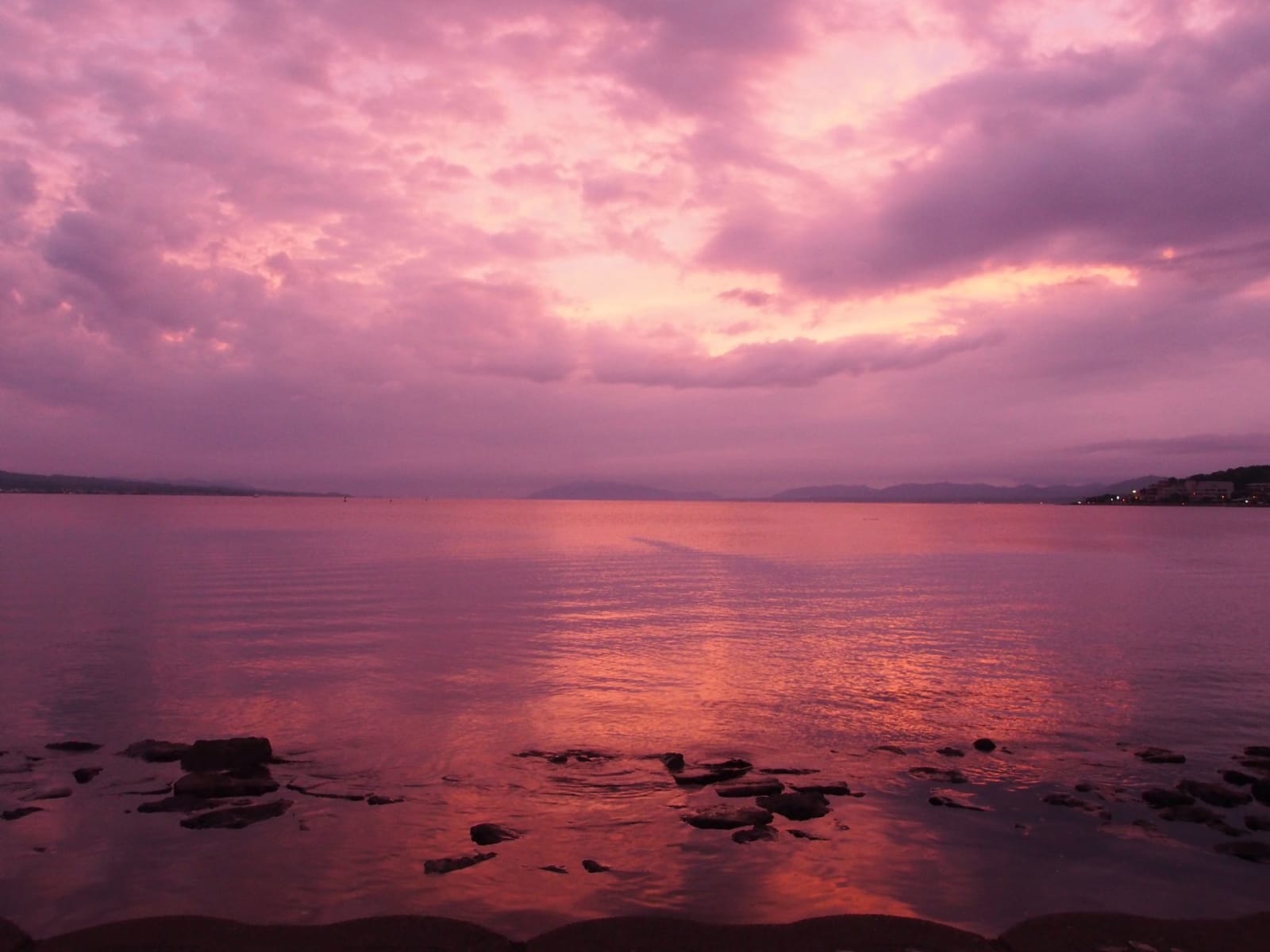
Japan's seventh-largest lake faces due west from Matsue's shore, and the sun setting behind Yomegashima islet is the city's daily event; the lakeside promenade by the Shimane Art Museum has terraced steps built for exactly this. Check the sunset time, arrive 30 minutes early, and let the sky do the work. The museum lobby (free to enter) is the wet-weather backup.
Where to Stay in Matsue
Two sensible bases. The station area has the reliable business hotels and the JR line east toward the Adachi Museum. Matsue Shinjiko Onsen, the small hot-spring strip on the lake's northern shore, has onsen hotels with sunset views and is the terminus of the Ichibata railway to Izumo Taisha; choose it if the lake evenings and shrine trip are your priorities.
Best Areas to Stay
Matsue Station Area
Business hotels within a few minutes of JR Matsue Station, with the castle a 20-minute walk or short bus ride away. The practical pick for rail-based day trips to the Adachi Museum.
Best for: Value, JR day trips, short stays
Matsue Shinjiko Onsen
A lakeside hot-spring strip at the Ichibata railway terminus, ten minutes by bus from the station. Onsen hotels here face the Lake Shinji sunset, and the Izumo Taisha train leaves from the doorstep.
Best for: Onsen baths, sunset views, the Izumo Taisha trip
Types of Accommodation
Business Hotels
Clean and cheap near the station; Dormy Inn's Matsue outpost adds the chain's baths and free late-night noodles.
Onsen Hotels
Full-service hot-spring hotels on the Shinjiko Onsen lakefront, with open-air baths and kaiseki dinners built around lake and Sea of Japan catch.
Best Time to Visit
Spring and autumn are the best times: mild weather for the castle and boats, cherry blossoms around the moat in early April, and clear-aired sunsets over Lake Shinji. Winter is the insider pick for kotatsu-heated boats and peak shijimi clam season. In the old calendar's tenth month, all of Japan's gods are said to gather at Izumo, and the shrine holds its Kamiari festivals (usually November).
Spring (March-May)
8-22°C (46-72°F)
Cherry blossoms ring the castle moat in early April, boat season restarts in earnest, and the samurai street is at its photogenic best. Comfortable walking weather throughout.
Pros:
- +Moat-side cherry blossoms in early April
- +Mild boat weather
- +Clear days for Lake Shinji sunsets
Cons:
- -Blossom week draws the year's biggest local crowds
- -Changeable early-spring rain
Summer (June-August)
20-32°C (68-90°F)
Humid Sea of Japan summer, softened by lake breezes in the evening. The Suigosai fireworks over Lake Shinji in early August are the region's biggest night of the year.
Pros:
- +Lake Shinji fireworks in early August
- +Long evenings on the water
- +Green moat scenery
Cons:
- -Heat and humidity at midday
- -Rainy season through mid July
Autumn (September-November)
10-24°C (50-75°F)
Crisp air, moat-side foliage, and the Suitoro lantern evenings around the castle. November brings the Kamiari season at Izumo Taisha, when the gods are said to convene; book shrine-area rooms early.
Pros:
- +Foliage around the castle
- +Kamiari season at Izumo Taisha
- +Clearest sunset weather
Cons:
- -November weekends busy at Izumo
- -Evenings turn cold
Winter (December-February)
1-9°C (34-48°F)
Grey, cold, and quietly atmospheric: the boats run with kotatsu blankets, snow occasionally dusts the black keep, and shijimi clams are at their seasonal peak.
Pros:
- +Kotatsu boats on the moat
- +Peak shijimi season
- +Near-zero crowds
Cons:
- -Cold wind off the lake
- -Shorter boat operating hours
Matsue Food Scene
Matsue eats from its lake and its shrine road. Lake Shinji's shijimi clams flavor the region's miso soup (locals credit them with curing hangovers, and act accordingly), while Izumo soba, dark and nutty, comes stacked in round lacquer tiers eaten in ritual order. Matsue also claims a place among Japan's great tea cities: the 18th-century lord Fumai-ko made tea ceremony a civic habit, and wagashi shops here rank with Kyoto's.
Shijimi Clam Miso Soup
Lake Shinji's small freshwater clams give the broth a depth no instant miso approaches. It appears at breakfast at nearly every hotel and ryokan in town, and lakeside restaurants serve rich shijimi bowls at lunch. Season peaks October through March.
Where to try:
Izumo Soba (Warigo Style)
Buckwheat milled with its dark hull, served in three stacked lacquer rounds: pour broth on the top tier, eat, then tip the remains onto the next. The most atmospheric shops line Izumo Taisha's approach street, and the castle area has solid options for a Matsue lunch.
Where to try:
Wagashi and Matcha
Matsue's tea-ceremony tradition means the confectionery here is serious: wakakusa (young grass) sweets are the local classic. Do it properly with a matcha set at a tea house near the castle, or buy boxes from the long-established makers to travel.
Where to try:
Suggested Itinerary
Nearby Day Trips
Izumo Taisha Grand Shrine
1 hour by Ichibata Railway from Matsue Shinjiko Onsen Station (¥820, change at Kawato)
Among Japan's oldest and most storied shrines, dedicated to Okuninushi, the deity of en-musubi: the ties that bind people, marriage above all. The giant twisted shimenawa rope over the Kagura-den is the icon, worshippers clap four times here instead of two, and in the old calendar's tenth month all eight million gods are said to check in. The approach street's warigo soba shops are half the reason to go.
Adachi Museum of Art
30 min by JR to Yasugi Station (¥420), then a free 20-min shuttle
A museum where the garden is the main collection: 165,000 square meters of living landscape ranked Japan's best garden for more than 20 consecutive years by the Journal of Japanese Gardening, framed through the building's windows like hanging scrolls. The Yokoyama Taikan painting collection inside is itself first-rate. Admission is ¥2,500 and worth it; the free shuttle from Yasugi Station runs every 30-60 minutes.
Practical Information
Getting to Matsue
From Tokyo
1.5 hours by flight from Haneda to Izumo Airport then 40 min by bus; or 6 hours by Shinkansen to Okayama then Yakumo Limited Express (¥22,000, JR Pass covered)
Daily Budget Guide
Business hotel single, soba and izakaya meals, castle and boat on foot
Comfortable hotel, boat day pass, one day trip, a proper seafood dinner
Shinjiko Onsen lakeside hotel with kaiseki, taxis, both day trips
Essential Matsue Tips
Do the castle at the 8:30am opening, then Shiomi Nawate before 10am; the day-trip buses arrive mid morning and leave by mid afternoon
The Horikawa boat ticket is an all-day pass with three landings; use it as transport, not just a single loop. Kotatsu boats run November to early April
Foreign visitors get the boat day pass for ¥1,200 with a passport; the castle also discounts foreign passport holders
Izumo Taisha trains run only about hourly and need a change at Kawato; photograph the return timetable at Matsue Shinjiko Onsen Station before boarding
Pray Izumo-style at the shrine: two bows, FOUR claps, one bow. The giant rope is at the Kagura-den, west of the main hall; most first-timers miss it
Eat warigo soba on Izumo Taisha's approach street, not in a hurry: broth goes onto the top tier, then gets poured down to the next as you finish each
The Adachi Museum shuttle from Yasugi Station is free but every 30-60 minutes; match your JR train to the shuttle timetable posted on the museum site
Sunset is the fixed appointment: check the time, be on the Shimane Art Museum terrace 30 minutes before, and let dinner wait
Shijimi soup is on nearly every hotel breakfast; locals swear by it for the morning after a sake evening, and the local Toji brewing tradition gives you cause to test it
Rail from Tokyo takes a real six hours; the Haneda-Izumo flight plus 40-minute airport bus is the time-saver, and works well one-way against a rail pass itinerary
Book tours & activities in Matsue
Skip the line with pre-booked tickets and guided tours
via Klook · Affiliate link
Other Destinations
Tokyo
The world's greatest city: 14 million people, 200+ Michelin stars, and more to discover than any single trip can hold
Hiroshima
Peace Park, Miyajima's floating torii, and the best okonomiyaki in Japan: a city that turned tragedy into hope
Kyoto
A thousand years as Japan's capital: geisha in Gion, vermillion torii tunnels, and kaiseki cuisine elevated to art
Osaka
Kuidaore city: Dotonbori's neon, Shinsekai's kushikatsu, and Japan's friendliest strangers
Kamakura
Tokyo's favorite day trip: the Great Buddha since 1252, zen temples, hydrangeas at Hasedera, surf beaches, and shirasu-don an hour from the city
Yokohama
Japan's largest Chinatown, Cup Noodles Museum, and a waterfront that actually breathes (25 minutes from Tokyo)
Hakone
Two hours from Shinjuku: volcanic onsen, the Hakone Loop, and Mt. Fuji (when she shows up)
Nikko
Gold-leaf Toshogu, 97m Kegon Falls, and yuba soba: Japan's most opulent shrine town, 2 hours from Asakusa
Nara
1,200 bowing deer, the world's largest bronze Buddha, and temples that predate Kyoto, 45 minutes from Osaka
Kanazawa
Kyoto's calmer cousin: Kenroku-en at dawn, Omicho seafood, and 99% of Japan's gold leaf
Takayama
Preserved Edo streets, world-class Hida beef, and six sake breweries you can walk between in the Japanese Alps
Fukuoka
Yatai stalls at sunset, the best tonkotsu ramen in Japan by the Naka River, and all of Kyushu on your doorstep
Sapporo
Miso ramen at midnight, powder snow at Niseko, and a beer garden in Odori Park: Hokkaido's capital delivers
Nagoya
Miso katsu, golden shachihoko, and Toyota's textile-to-car story: the city everyone skips on the Shinkansen, and shouldn't
Kobe
Kobe beef that ruins all other steak, historic Kitano mansions, and Arima Onsen in the mountains
Nagasaki
Japan's only window to the outside world for 200 years: now champon, Dejima, and the Peace Park
Hakodate
One of the world's three best night views, a star-shaped fort, and the freshest kaisen-don in Japan at sunrise
Otaru
Gas-lit canals, port-fresh sushi, and Hokkaido's most romantic winter festival
Asahikawa
The zoo that redesigned how Japan thinks about animals, a ramen style with a pork-fat layer to beat the cold, and the gateway to Japan's largest national park
Sendai
Tohoku's capital: grilled beef tongue since 1948, Date Masamune's ornate mausoleum, and streamers across the sky every August
Aomori
Honshu's northern edge: Japan's most electrifying summer festival, world-class Jomon archaeology, and one of the last virgin beech forests on Earth
Morioka
Three completely distinct noodles, 1,000 cherry trees on a ruined castle, and Hiraizumi's Golden Hall 45 minutes south
Akita
Gravity-defying lantern poles at the Kanto Festival, Tohoku's finest samurai streets in Kakunodate, and sake from over thirty breweries
Yamagata
Yamadera's 1,015 steps, Ginzan Onsen's gaslit snow, sacred mountains, and Japan's best cherries
Fukushima
A blossom-covered mountain, a volcanic sky road, 200-yen Edo bathhouses, and Japan's best peaches, 90 minutes from Tokyo
Matsushima
One of Japan's three great views: 260 pine-clad islands, Date Masamune's Zen temple, and oysters grilled on the bay
Hirosaki
Japan's greatest cherry blossom castle, fan-shaped warrior floats at Neputa, and a city that produces one in five of Japan's apples
Aizuwakamatsu
A red-tiled castle, nineteen graves of teenage samurai, thatched Edo villages, and some of Japan's most decorated sake
Chiba
Narita-san Shinsho-ji, Tokyo DisneySea, and 100 km of Pacific coastline: most visitors see only the airport terminal
Saitama
Kawagoe's Edo warehouse street, Japan's first Shinkansen prototype, and the Chichibu Night Festival: Saitama earns a day
Mito
Japan's first flower season: Kairakuen's 3,000 plum trees six weeks before sakura, one of Japan's Three Great Gardens
Utsunomiya
Japan's gyoza capital: 200 shops, underground volcanic caverns at Oya, and Nikko 41 minutes by train
Maebashi
A free rose garden with 7,000 blooms, a volcanic caldera you can walk around, and the budget base for Kusatsu Onsen
Niigata
Japan's sake heartland: 90-plus breweries, Sea of Japan sushi at half the Tokyo price, and a ferry to Sado Island
Toyama
Base camp for the Tateyama snow walls, with white shrimp, firefly squid, and Sea of Japan sushi at half Tokyo prices
Fukui
Japan's dinosaur prefecture: a world-class museum, volcanic sea cliffs, the strictest Zen monastery, and Echizen crab in winter
Nagano
Zenko-ji pilgrims, snow monkeys in hot springs, and Hakuba powder: Japan's alpine heart
Shizuoka
Japan's tea capital: pine-framed Fuji views, the Tokugawa shrine that predates Nikko, and tiny pink shrimp found only in Suruga Bay
Gifu
Cormorant fishing by firelight, a mountain castle at sunset, and the gateway to Shirakawa-go's thatched villages
Kofu
Japan's wine capital: cellar tours a short walk from the station, hoto noodles, and the granite cliffs of Shosenkyo Gorge
Hakuba
Olympic powder, alpine hiking, and the most international mountain town in Japan
Matsumoto
Japan's oldest castle, alpine gateways, and a city that punches well above its size
Wakayama
Pilgrimage country: sleep in Koyasan's temples, walk the Kumano Kodo, and stand under Japan's tallest waterfall
Otsu
Kyoto's lakeside escape: Enryaku-ji's World Heritage halls, Japan's largest lake, and hotel rates Kyoto forgot, 10 minutes away
Tsu
Ise Jingu 50 minutes, Matsusaka wagyu 20 minutes: Tsu is the affordable base for the best of Mie Prefecture
Miyajima
A floating shrine gate, a 535-metre sacred mountain, and Hiroshima oysters grilled on the waterfront
Okayama
Korakuen garden, Crow Castle, Kurashiki canals, plus Naoshima art island 50 minutes away
Tottori
Japan's only coastal sand dunes, 50 meters high and 16km wide, where the desert meets the Sea of Japan
Yamaguchi
Ruriko-ji's 1442 national treasure pagoda, Japan's largest limestone cave, and the gateway to Hagi and fugu country
Matsuyama
Japan's oldest hot spring, one of 12 original castles, and the gateway to the Shimanami Kaido cycling route
Takamatsu
Japan's udon capital, a Michelin three-star garden, and the ferry gateway to Naoshima's art islands
Tokushima
Japan's wildest dance festival, vine bridges over mountain gorges, and tidal whirlpools at the edge of Shikoku
Kochi
One of Japan's five original castles, a 300-year-old Sunday market, and katsuo no tataki seared over straw flames
Kumamoto
Japan's fiercest castle, garlic-laced ramen, and the world's largest active caldera: Kyushu's samurai heart
Beppu
Eight volcanic 'hells,' Takegawara sand baths, and Japan's densest onsen: steam rises from every corner
Kagoshima
Sakurajima erupting on the horizon, kurobuta pork on your plate, and Yakushima's 7,000-year-old cedars a ferry away
Miyazaki
Takachiho Gorge by rowboat, a shrine built into a sea cave, and chicken nanban from the city that invented it
Saga
The birthplace of Japanese porcelain, a hundred balloons over a river at dawn, and A5 wagyu at a fraction of Kobe prices
Oita
12th-century stone Buddhas in a cedar valley, toriten from its originator, and Beppu's steaming hells 28 minutes down the line
Naha
Shuri Castle, Kokusai-dori, and goya champuru: Japan's subtropical capital where Ryukyu royalty once ruled
Ishigaki
Kabira Bay emerald waters, world-class diving, and Japan's southernmost island gateway
Miyako Island
7km of turquoise sand, Ikema Bridge views, and Japan's clearest snorkeling
Ready to Explore Matsue?
Add Matsue as a stay in your trip and we'll help you find hotels and suggest activities