When Can You See Mt Fuji? Visibility Odds by Month and Date
How often Mt Fuji is visible: 60% of January mornings, 10% in July. Odds by month, hour and date from Fuji City's 35-year record, plus Tokyo's own count.
The short answer: from November to February, and in the morning. Mt Fuji hides far more often than the postcards suggest, and summer is the worst of it. The figures here come from the record Fuji City has kept every day since 1990: the odds for every month and date of the year and for three hours of the day, then what is known for Tokyo, Hakone, Kawaguchiko and the Shinkansen.
Fuji City's figure for how often the mountain was visible on this date, 1991 to 2023. It runs below the morning odds: why.
Share of October days with the whole mountain visible at 8:00. Part of it showed on another 28%.
The whole mountain was in view at 36.6% of the 8:00 looks, 23.3% at noon and 22.5% at 16:00, the three hours the city records.
These are odds from past years, not a forecast for today. To see the mountain right now, use the official live cameras.
Where These Numbers Come From
Fuji City has looked at the mountain three times a day since May 1990. The city sits on the south side, between the summit and Suruga Bay, and its staff note at 8:00, noon and 16:00 whether the whole mountain is visible from city hall, part of it, or none of it. The city began because its plan to protect the landscape needed a record of the view and none existed. It publishes the result once a year, and the figures here run from 1991 to 2025.
Two kinds of number appear in this article. The calendar above is the city's "rate at which Mt Fuji was visible" for each date, worked out with the National Institute of Technology, Numazu College from the years 1991 to 2023. The city does not say how that rate is counted. The figures point to one reading, and this article uses it: the share of all three daily looks at which the whole mountain was in view. On that reading they run lower than the monthly table below, which counts the 8:00 look alone, the best of the three. Both describe one viewpoint. Other places see the mountain from other sides and distances, and what is known about them is in the section on places.
Check Your Dates
Pick the days you will be near the mountain. The bars show Fuji City's figure for how often the mountain was visible on each date, 1991 to 2023. By our reading it covers the noon and afternoon looks as well as the morning one, so the odds at 8:00 are higher: those are in the monthly table below.
October 3 to October 9: Fuji City's figure averages 18% across these dates, and the best single date is October 8 at 25%.
Mt Fuji Visibility by Month
December is the best month and July the worst. At 8:00 the whole mountain is visible on more than half of all mornings from November to February, on 30 to 41% from March to May, and on 10 to 15% from June to August. The city's report gives a reason for two of the weaker stretches: spring haze from March to May, and the typhoon season in September.
| 8:00, 1991 to 2025 | Whole mountain | Part of it | Nothing | Whole, 2025 |
|---|---|---|---|---|
| JanJanuary | 60.0% | 22.3% | 17.7% | 61.3% |
| FebFebruary | 52.6% | 22.3% | 25.1% | 78.6% |
| MarMarch | 40.7% | 20.6% | 38.7% | 41.9% |
| AprApril | 36.3% | 22.0% | 41.7% | 30.0% |
| MayMay | 30.2% | 20.9% | 48.8% | 29.0% |
| JunJune | 12.4% | 21.4% | 66.2% | 6.7% |
| JulJuly | 9.9% | 14.7% | 75.4% | 16.1% |
| AugAugust | 14.6% | 21.0% | 64.4% | 9.7% |
| SepSeptember | 27.2% | 26.8% | 46.0% | 20.0% |
| OctOctober | 41.1% | 27.6% | 31.2% | 32.3% |
| NovNovember | 53.9% | 24.8% | 21.3% | 63.3% |
| DecDecember | 61.7% | 23.2% | 15.1% | 61.3% |
Share of days in each month, at the 8:00 observation. Fuji City's Mt Fuji observation record.
Best Time of Day to See Mt Fuji
Morning, by a wide margin. The whole mountain was visible at 36.6% of all 8:00 observations, against 23.3% at noon and 22.5% at 16:00. The city's report says only that the mountain gets harder to see as the afternoon goes on. The record has no look earlier than 8:00, so it cannot say whether sunrise is better still. In 2025 the mountain was in full view at all three looks on 62 days, and hidden at all three on 77.
| All year, 1991 to 2025 | 8:00 | 12:00 | 16:00 |
|---|---|---|---|
| Whole mountain visible | 36.6% | 23.3% | 22.5% |
| Part of it visible | 22.3% | 30.1% | 27.2% |
| Nothing visible | 41.1% | 46.6% | 50.3% |
A Sunny Forecast Is Not Enough
In summer the weather where you stand tells you little about the mountain. Fuji City also logs whether its own sky is clear at 8:00. In winter the two counts are close: 21.3 clear mornings in an average January, 18.6 with the whole mountain in view. From May to September they come apart, and in July the city has 12.1 clear mornings but the mountain on only 3.1. The report's explanation: even in fine weather on the plain, cloud and mist around the mountain hide it.
| Mornings a year | Jan | Feb | Mar | Apr | May | Jun | Jul | Aug | Sep | Oct | Nov | Dec |
|---|---|---|---|---|---|---|---|---|---|---|---|---|
| Clear sky | 21 | 18 | 17 | 16 | 16 | 11 | 12 | 17 | 15 | 17 | 20 | 22 |
| Whole mountain | 19 | 15 | 13 | 11 | 9 | 4 | 3 | 5 | 8 | 13 | 16 | 19 |
Mornings a year
| Mornings a year | Jan | Feb | Mar | Apr | May | Jun |
|---|---|---|---|---|---|---|
| Clear sky | 21 | 18 | 17 | 16 | 16 | 11 |
| Mountain | 19 | 15 | 13 | 11 | 9 | 4 |
| Mornings a year | Jul | Aug | Sep | Oct | Nov | Dec |
|---|---|---|---|---|---|---|
| Clear sky | 12 | 17 | 15 | 17 | 20 | 22 |
| Mountain | 3 | 5 | 8 | 13 | 16 | 19 |
Clear sky in Fuji City against the whole mountain in view: average days per month at 8:00, 1991 to 2025, worked out from the totals in the city's report.
Can You See Mt Fuji From Tokyo, Hakone or Kawaguchiko?
The odds change with where you stand: how far away, which side, and how much air and city lie in between. Only Fuji City and Tokyo publish a count. Here is what each place has.
Can You See Mt Fuji From Tokyo?
East-north-east of the mountain; look west-south-west, over the city
Yes, on about one morning in four over the year, and mostly in winter. Tokyo's Bureau of Environment photographs the view from the Metropolitan Government Building in Shinjuku at 9:00 every day and counts the days the mountain shows: 95 a year on average since fiscal 1992, with 19 in an average January, 18 in December, 14 in February and 11 in November, against about 2 a month from June to August. The count has risen: the last ten fiscal years averaged 115 days against 86 in the first ten, and fiscal 2023 set the record at 135. (The camera moved from one tower of the building to the other in fiscal 2003, so the two periods are not quite like for like.)
Further west, the Seikei Meteorological Observatory in Musashino, about 83 km from the summit, has counted since 1963; it reports about 50 visible days a year in the 1960s and more than 150 now, and puts the change down to cleaner air and lower humidity. Neither body says whether a partly hidden mountain counts.
To look for yourself, the government building's observatories on the 45th floor are free, and their west side is the one that faces the mountain. Another free viewpoint, the lounge at Bunkyo Civic Center, is closed for building works and due to reopen in early December 2026. Tokyo travel guide →
| From Shinjuku, 9:00 | Jan | Feb | Mar | Apr | May | Jun | Jul | Aug | Sep | Oct | Nov | Dec |
|---|---|---|---|---|---|---|---|---|---|---|---|---|
| Days visible | 19 | 14 | 9 | 5 | 4 | 2 | 2 | 2 | 3 | 6 | 11 | 18 |
| Share of month | 62% | 48% | 30% | 16% | 14% | 6% | 8% | 5% | 10% | 19% | 38% | 58% |
From Shinjuku, 9:00
| From Shinjuku, 9:00 | Jan | Feb | Mar | Apr | May | Jun |
|---|---|---|---|---|---|---|
| Days | 19 | 14 | 9 | 5 | 4 | 2 |
| Share | 62% | 48% | 30% | 16% | 14% | 6% |
| From Shinjuku, 9:00 | Jul | Aug | Sep | Oct | Nov | Dec |
|---|---|---|---|---|---|---|
| Days | 2 | 2 | 3 | 6 | 11 | 18 |
| Share | 8% | 5% | 10% | 19% | 38% | 58% |
Average since fiscal 1992; 111 days in fiscal 2025 (April 2025 to March 2026). Tokyo Bureau of Environment.
Can You See Mt Fuji From Hakone?
South-east of the mountain: Lake Ashi, Owakudani and the ropeway
Yes: from Lake Ashi, from Owakudani and from the ropeway cabins between the two, when the sky is clear. Nobody in Hakone publishes a count, so there are no odds to quote. Hakone Navi, the Odakyu group's site for the area, recommends winter, when the air is clear, and early morning at Lake Ashi, when the lake mirrors the mountain. That is the same season and the same hour as the Fuji City record, so use the monthly figures above as a guide, and look at the tourism association's Lake Ashi camera before you ride up. Hakone travel guide →
Can You See Mt Fuji From Kawaguchiko and the Fuji Five Lakes?
At the mountain's northern foot: Kawaguchiko, Yamanakako, Fujiyoshida, Oshino
Yes, whenever the weather lets it show: the lakes lie at the mountain's northern foot. No town or operator here publishes a count, and Fuji City's figures come from the opposite side, so read them as a guide to the season, not as Kawaguchiko's odds. The Kawaguchiko ropeway's FAQ says only that the chance of seeing the mountain goes up in winter, when little rain or snow falls. Fujiyoshida's tourism site tells visitors to check its live camera at Arakurayama Sengen Park, the Chureito Pagoda view, before they set out. Copy the habit: Fujikawaguchiko, Yamanakako, Fujiyoshida and Oshino each keep a camera on the mountain.
Mt Fuji From Shizuoka: Fuji City, Fujinomiya and Nihondaira
South and south-west of the mountain, down to Suruga Bay: Fuji City, Fujinomiya, Shimizu, Nihondaira, and Gotemba at the eastern foot
This is the side the figures on this page describe: Fuji City takes its record from the 8th floor of its city hall. Shizuoka Prefecture runs cameras at Shimizu Port, Fujinomiya and Gotemba that take a picture every minute and keep one for each hour from 4:00 to 20:00, so you can see how the morning went before you set out. The prefecture warns that on some days the mountain does not show. Fuji City keeps hourly stills from its own camera going back to January 1999, the nearest thing anywhere to looking through the record yourself. Shizuoka travel guide →
Can You See Mt Fuji From the Shinkansen?
Tokaido Shinkansen, which passes south of the mountain between Tokyo and Shizuoka
Yes, from the mountain side of the train: seat E in either direction, or seat D in a Green Car. JR Central names two stretches, Shin-Yokohama to Odawara and Mishima to Shin-Fuji, and its travel company, JR Tokai Tours, puts the best of it in the three minutes or so around Shin-Fuji Station. The view is cleaner from Tokyo-bound trains, which have no oncoming trains in the way, and at its best from December to February, the same guide says. On the sea side, seat A may get a glimpse between Shizuoka and Kakegawa on a clear winter day.
Neither company says how often the mountain shows, but Shin-Fuji Station is in Fuji City, where the record on this page is kept: a morning train in January has about six chances in ten of the whole mountain, a July train about one in ten.
Seeing Mt Fuji From a Plane
Domestic flights in and out of Tokyo Haneda
On flights out of Haneda the mountain comes into view 10 to 15 minutes after take-off, by Japan Airlines' own guide. Which window depends on the airway: of the six heading west, the four north of the mountain put it on the left and the two south of it on the right. Every flight into Haneda from the west passes south of it, so sit on the left. Routes that fly almost straight over the top, Kumamoto and Oita among them, show next to nothing. The airline's page gives the side route by route, and says the mountain may look sharper in winter, when the air holds less moisture.
Can You See Mt Fuji From Kamakura and Enoshima?
East of the mountain, looking west across Sagami Bay
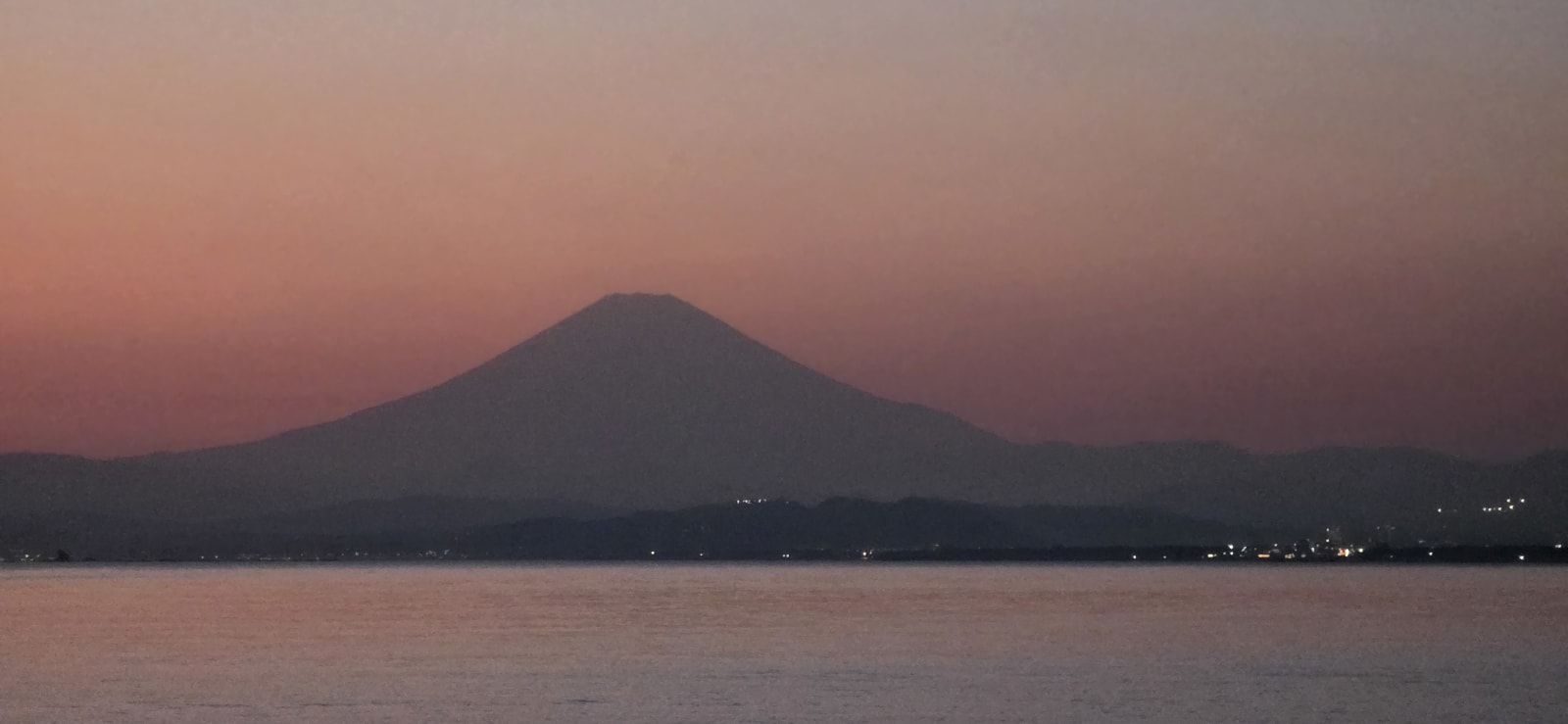
On a clear day, yes, across Sagami Bay, but nobody counts how often. Kamakura's tourism association lists viewpoints from Inamuragasaki to the hill behind Komyoji temple, says that along the shore the mountain is often no more than a faint ridge line, and calls a sharp view lucky. For the silhouette at dusk it names Shonan-Fukasawa Station on the Shonan Monorail, and the monorail keeps a camera on the roof terrace of Shonan-Enoshima Station pointed at the mountain, refreshed every ten minutes from 4:00 to 20:00. Kamakura travel guide →
Is Mt Fuji Visible Right Now?
Look at a live camera: nothing else will tell you. We know of no official daily verdict on whether the mountain is out, and Fuji City's record is published once a year, so the figure for today's date at the top of this article is history, not a forecast. These cameras are run by the towns and operators themselves:
- Tokyo: Mt Fuji camera, Metropolitan Government Building, a still every hour (Tokyo Bureau of Environment)
- Hakone: Lake Ashi view camera (Hakone Tourism Association)
- Kawaguchiko and the Fuji Five Lakes: Lake Kawaguchiko north shore (Fujikawaguchiko Town), Lake Yamanakako cameras (Yamanakako Tourism Association), Arakurayama Sengen Park, the Chureito Pagoda view (Fujiyoshida's official tourism guide)
- The Shizuoka side: Fuji City hall (Fuji City), Gotemba (Shizuoka Prefecture), Nihondaira Yume Terrace (Nihondaira Yume Terrace)
- Kamakura and Enoshima: Fuji view camera, Shonan-Enoshima Station (Shonan Monorail)
For a forecast there is the Mt Fuji view index from Weathernews: a two-day forecast, in four ranks, of how well the mountain will show from other summits. It is built for hikers and covers peaks only, not towns, lakesides or city viewpoints.
Year by Year: 35 Years of Mornings With Mt Fuji in View
An average year has 134 mornings with the whole mountain in view, 36.6% of the year. The best was 2021, with 162; the worst was 2018, with 98. There is no trend to speak of: the first ten years of the record averaged 133 a year and the last ten 138, a gap far smaller than the swing from one year to the next. Count the mornings when at least part of the mountain showed and the yearly share rises to 59%.
Every year's count
Every Date of the Year
The best single date is December 26 (70.8%), and the best week December 21 to December 27, which averages 60.1%. The worst week is June 20 to June 26, at 3.9%, and the lowest single date is July 2, at 0%.
The calendar as a table
| Day | Jan | Feb | Mar | Apr | May | Jun | Jul | Aug | Sep | Oct | Nov | Dec |
|---|---|---|---|---|---|---|---|---|---|---|---|---|
| 1 | 63 | 38 | 23 | 32 | 28 | 12 | 6 | 8 | 10 | 14 | 34 | 36 |
| 2 | 58 | 38 | 31 | 31 | 20 | 14 | 0 | 3 | 6 | 24 | 46 | 47 |
| 3 | 58 | 56 | 23 | 30 | 29 | 11 | 2 | 5 | 9 | 22 | 47 | 42 |
| 4 | 60 | 48 | 24 | 36 | 34 | 20 | 8 | 10 | 9 | 11 | 46 | 50 |
| 5 | 55 | 33 | 27 | 34 | 31 | 12 | 5 | 6 | 9 | 14 | 37 | 51 |
| 6 | 47 | 44 | 30 | 37 | 20 | 3 | 4 | 4 | 8 | 11 | 40 | 48 |
| 7 | 50 | 44 | 29 | 28 | 19 | 9 | 4 | 9 | 10 | 21 | 39 | 48 |
| 8 | 52 | 47 | 41 | 27 | 29 | 11 | 5 | 4 | 10 | 25 | 32 | 42 |
| 9 | 62 | 42 | 34 | 28 | 27 | 5 | 3 | 7 | 13 | 20 | 38 | 41 |
| 10 | 51 | 42 | 29 | 30 | 27 | 14 | 5 | 8 | 8 | 30 | 31 | 41 |
| 11 | 48 | 48 | 34 | 25 | 27 | 1 | 8 | 7 | 19 | 27 | 35 | 49 |
| 12 | 46 | 44 | 38 | 25 | 21 | 9 | 3 | 5 | 16 | 32 | 32 | 53 |
| 13 | 53 | 47 | 35 | 35 | 21 | 5 | 3 | 4 | 14 | 25 | 47 | 38 |
| 14 | 59 | 35 | 39 | 35 | 25 | 8 | 5 | 4 | 7 | 21 | 41 | 54 |
| 15 | 38 | 47 | 29 | 27 | 22 | 7 | 4 | 7 | 12 | 22 | 44 | 57 |
| 16 | 44 | 53 | 31 | 29 | 14 | 8 | 6 | 11 | 12 | 31 | 41 | 62 |
| 17 | 38 | 39 | 31 | 22 | 10 | 10 | 4 | 9 | 18 | 19 | 34 | 48 |
| 18 | 40 | 46 | 31 | 38 | 29 | 4 | 5 | 6 | 17 | 23 | 39 | 58 |
| 19 | 51 | 33 | 24 | 25 | 29 | 10 | 2 | 6 | 16 | 22 | 46 | 43 |
| 20 | 45 | 41 | 30 | 24 | 21 | 5 | 5 | 12 | 21 | 21 | 39 | 54 |
| 21 | 37 | 43 | 26 | 18 | 24 | 3 | 8 | 6 | 16 | 25 | 41 | 63 |
| 22 | 31 | 50 | 27 | 29 | 21 | 6 | 6 | 4 | 16 | 24 | 40 | 50 |
| 23 | 37 | 49 | 20 | 17 | 13 | 1 | 5 | 5 | 23 | 33 | 47 | 64 |
| 24 | 43 | 39 | 26 | 13 | 18 | 6 | 4 | 9 | 16 | 24 | 49 | 59 |
| 25 | 60 | 31 | 29 | 24 | 21 | 3 | 8 | 4 | 16 | 33 | 57 | 55 |
| 26 | 54 | 32 | 31 | 27 | 18 | 3 | 9 | 8 | 9 | 31 | 42 | 71 |
| 27 | 46 | 33 | 31 | 28 | 14 | 6 | 5 | 5 | 21 | 33 | 49 | 60 |
| 28 | 59 | 45 | 29 | 25 | 12 | 7 | 10 | 9 | 21 | 30 | 48 | 58 |
| 29 | 44 | 30 | 30 | 19 | 8 | 7 | 13 | 14 | 33 | 40 | 45 | |
| 30 | 42 | 28 | 29 | 14 | 8 | 5 | 14 | 21 | 32 | 43 | 49 | |
| 31 | 51 | 30 | 5 | 5 | 6 | 39 | 54 | |||||
| Mean | 49 | 42 | 30 | 28 | 22 | 8 | 5 | 7 | 14 | 25 | 41 | 51 |
Fuji City's "rate at which Mt Fuji was visible", in percent, 1991 to 2023. Fuji City's calendar.
How to Give Yourself the Best Chance
- Come between November and February if the mountain matters. The odds at 8:00 are 54%, 62%, 60% and 53% in those four months, and the summit is white, which is the picture most people have in mind. The first snowcap is tracked on our snow season page.
- Sleep near it and look first thing. The odds drop by more than a third between 8:00 and noon. A night in Hakone or at the Fuji Five Lakes gets you a morning that a day trip from Tokyo does not.
- Give it two mornings. Even in January the whole mountain is out on six mornings in ten, not ten.
- In summer, plan for not seeing it. June to August is the worst time to see the mountain from below, and most of the climbing season (July to early September) falls inside it. If you are going up, the dates are on our Mt Fuji climbing season tracker.
Frequently Asked Questions
What is the best month to see Mt Fuji?
December, closely followed by January. In Fuji City's record for 1991 to 2025, the whole mountain was visible at 8:00 on 61.7% of December mornings and 60% of January mornings. November to February is the season; July is the worst month, at 9.9%.
What time of day is Mt Fuji most visible?
Morning. Over 35 years the whole mountain was in view at 36.6% of the 8:00 observations, 23.3% at noon and 22.5% at 16:00. Fuji City's record has no look earlier than 8:00, so it cannot say whether sunrise is better still, but the direction is plain: the later in the day, the less often the mountain shows.
How often can you actually see Mt Fuji?
At 8:00, the whole mountain is visible on 36.6% of days over the year and part of it on another 22.3%, as seen from Fuji City on the south side; on 41.1% of mornings nothing shows at all. That works out to about 134 mornings a year with the whole mountain in view, ranging from 98 in 2018 to 162 in 2021.
Can you see Mt Fuji in summer?
Rarely, and that surprises people because July to early September is the climbing season. The whole mountain was visible at 8:00 on 9.9% of July mornings and 14.6% of August mornings. It is not a matter of rain: in August Fuji City averages 16.6 clear mornings but only 4.5 with the whole mountain in view. The city's report gives the reason: cloud and mist around the mountain hide it even when the weather on the plain is fine.
If the forecast says sunny, will I see Mt Fuji?
In winter, usually. In summer, usually not. From October to April the number of clear mornings in Fuji City and the number of mornings with the whole mountain in view are close (in January, 21.3 against 18.6 a year). From May to September they come apart: in July, 12.1 clear mornings but only 3.1 with the mountain. The city's own report puts it plainly: fine weather on the ground does not mean the mountain is out.
Which single days of the year are best for seeing Mt Fuji?
December 26 is the best single date in Fuji City's figures for each day of the year, at 70.8%, and the best week runs from December 21 to December 27, averaging 60.1%. The worst week is June 20 to June 26, at 3.9%. The city does not define the figure; by our reading it covers the noon and afternoon looks as well as the morning one, which is why it sits below the 8:00 odds for the same months.
Can you see Mt Fuji from Tokyo?
Yes, on about 95 days a year, most of them in winter. Tokyo's Bureau of Environment photographs the view from the Metropolitan Government Building in Shinjuku at 9:00 every day: the mountain shows on about 19 days in an average January and 18 in December, against about 2 in August. In fiscal 2025 it was visible on 111 days, and the record is 135 in fiscal 2023.
Has Mt Fuji become harder to see over the years?
Not in this record. The whole mountain was visible at 8:00 on an average of 133 days a year in the first ten years (1991 to 2000) and 138 in the last ten (2016 to 2025). Single years swing far more than that: 98 days in 2018, 162 in 2021.