Japan Etiquette: The Rules That Actually Matter
Nobody expects you to bow correctly. They do expect quiet trains, no eating while walking, and shoes off at the door. The short list that counts.
Here's the reassuring truth about Japanese etiquette: as a visitor you're graded on effort, not execution. Nobody expects you to bow at the correct angle or master keigo honorifics. What locals actually notice is a much shorter list: keep your voice down on trains, don't eat while walking, take your shoes off where floors change level, and don't tip. Get those four right and you'll read as a considerate guest everywhere you go. This guide is the full working set, organized by where you'll actually need it, with the reasoning behind each rule (they all have one).
The Big Four (Learn These, Skip the Rest If You Must)
- Trains are quiet zones. No phone calls, conversations at a murmur, phones on silent (the Japanese term is literally "manner mode"). The train is the one shared space in a crowded country where everyone gets peace, and it's the fastest way visitors accidentally stand out. Talking is fine; projecting isn't.
- Don't eat while walking. Buy the street food, then stand and eat it next to the stall, or find a bench. This is also why there are so few public trash cans: you're expected to finish where you bought it (and hand the wrapper back to the vendor) or carry your trash home. A spare plastic bag in your day pack solves Japan's most-complained-about logistics problem.
- Shoes off at the step. The signal is a change in floor level plus a rack of slippers: at ryokan, temples, some restaurants, fitting rooms, and every private home. Step out of your shoes onto the raised floor (never stand in the entryway in socks, then step back onto the shoe area). Slip-on shoes will save you minutes a day, and holes in your socks will haunt you.
- No tipping. Ever. Anywhere. Not restaurants, not taxis, not hotels, not guides. There's no hidden expectation and no one is underpaid because of you; good service is the baseline, not a transaction. Leaving cash on a table causes genuine confusion, and staff will chase you down the street to return it. The one graceful exception: at a ryokan, a small gift from your home country for exceptional hospitality is appreciated, but never money handed over openly.
Eating and Drinking
- Say the words. "Itadakimasu" before eating and "gochisosama deshita" when leaving are the two highest-value phrases in Japanese: effort points far beyond their difficulty.
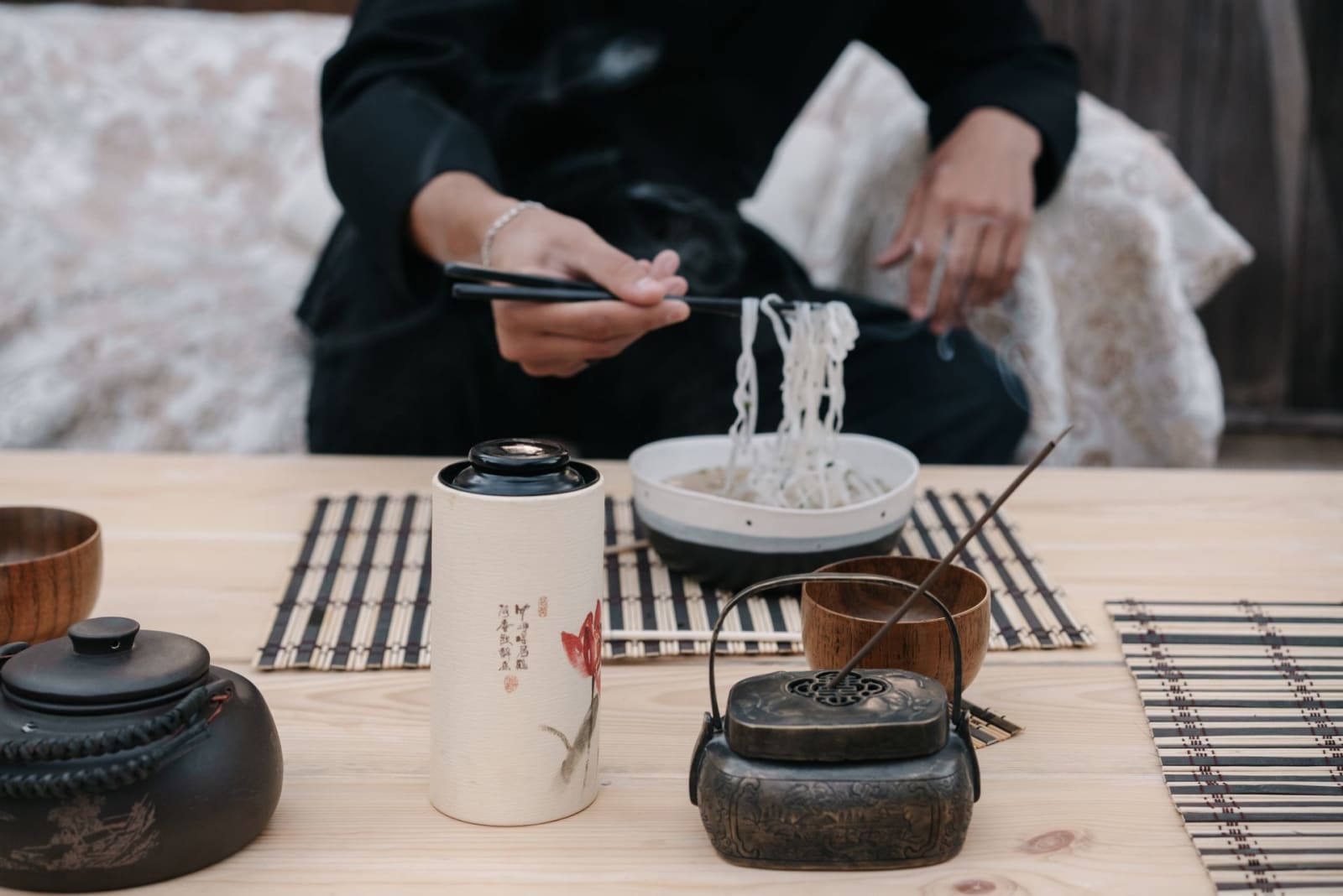
- The two real chopstick taboos: never stand them upright in rice, and never pass food chopstick-to-chopstick. Both mimic funeral rites and genuinely jar people. Everything else (crossing them, minor fumbling) is noise; resting them on the holder or across your bowl is fine.
- Slurping noodles is correct. It cools the noodles and signals enjoyment. The louder tables in a ramen shop are the locals.
- Pour for others, not yourself. At an izakaya, fill your companions' glasses and someone will fill yours. Wait for the collective "kanpai!" before the first sip.
- Don't rub disposable chopsticks together (it implies the restaurant is cheap), and put cash on the little tray by the register rather than into the cashier's hand; that's what the tray is for.
- Book-and-show restaurants take no-shows seriously. If you reserve a small counter restaurant and can't make it, cancel. Ghosting an 8-seat sushi counter is the one tourist behavior that actually makes local news.
The full restaurant playbook, from ticket-machine ramen shops to conveyor sushi, is in our first-timer's restaurant guide.
Trains, Streets, and Queues
- Queue where the marks are. Platform floors show exactly where doors open, and the line forms on the marks. Let passengers off before boarding; the flow works because everyone honors it.
- Escalators: stand left in Tokyo, right in Osaka. Nobody knows why the split exists either, but follow the person in front of you and you can't go wrong.
- Backpacks come off on crowded trains, worn on your front or set by your feet. Priority seats get vacated for those who need them, and phone calls end before boarding.
- Jaywalking reads worse here. Locals wait for the light even on an empty street at midnight, especially in front of children. When in Rome, wait for the green man.
- Blowing your nose in public is the impolite one (sniffing, oddly, is fine). Step aside or find a restroom.
Temples, Shrines, and Photos
- The basics cover you: be quiet, don't enter roped areas, and photograph only where signs allow (many temple interiors prohibit it; the signs are clear). At a shrine, walking along the edge of the path rather than dead center is the traditional courtesy, and the water pavilion is for rinsing hands, not drinking.
- Praying is optional and welcome. If you want to do it right at a shrine: coin in the box, two bows, two claps, a moment, one bow. Nobody is grading you.
- Photographing people requires the same courtesy as anywhere, and more so in Kyoto: the geiko and maiko of Gion are working professionals on their commute, and chasing them for photos got several alleys closed to tourists entirely. Zoom lenses and restraint.
- Tattoos: fine on the street everywhere, complicated at baths. Our onsen etiquette guide covers the whole bathing ritual, which is its own world of rules and the one place they're strictly enforced.
What You're Worried About That Doesn't Matter
- Bowing technique. A small nod of acknowledgment is plenty from a visitor. You'll start doing it unconsciously by day three anyway, including on the phone.
- Speaking Japanese. "Sumimasen" (excuse me / sorry / thank you, the universal social lubricant) and "arigato gozaimasu" cover 90% of interactions. Effort is noticed; fluency is not expected.
- Using the wrong honorific, sitting wrong, gift-wrapping errors. These matter between Japanese people in formal settings. Tourists get an automatic, genuine pass.
- Making a mistake at all. The response to a visitor's honest error is almost always a smile and a gesture toward the right way. Curiosity and apology cover everything; the only unforgivable behavior is not caring.
Etiquette is one chapter of trip-readiness; our complete beginner's guide covers the rest, and the trip planner turns it into an actual itinerary.
Frequently Asked Questions
Do you tip in Japan?
No, never: not in restaurants, taxis, hotels, or anywhere else. Good service is the baseline and tipping causes genuine confusion; staff will often chase you down to return the money. The polite alternative for exceptional ryokan hospitality is a small gift from your home country, never openly handed cash.
What are the biggest etiquette mistakes tourists make in Japan?
Talking loudly or taking phone calls on trains, eating while walking, wearing shoes past a raised floor entrance, and trying to tip. Those four cover most friction. Chopstick taboos matter too: never stand them upright in rice or pass food chopstick to chopstick, as both echo funeral rituals.
Is it rude to eat while walking in Japan?
Yes, mildly: the custom is to eat next to the stall or shop where you bought the food, then move on. It also explains the famous lack of public trash cans, since waste is handed back to the vendor or carried home. Keep a spare bag in your day pack for wrappers.
Do I need to learn to bow in Japan?
No. A small nod of acknowledgment is plenty from a visitor; the precise angles and durations are for Japanese business and formal life, and tourists get a genuine pass. Learning 'sumimasen' and 'arigato gozaimasu' earns far more goodwill than any bow.
Which side do you stand on escalators in Japan?
Left in Tokyo and most of the country, right in Osaka and much of Kansai. The origin of the split is debated even locally, so just match the person in front of you. Either way, leave the other side clear for walkers.
Can I take photos at temples and shrines in Japan?
Outdoors, almost always yes. Interiors are often no-photo zones and the signs are clear, so look before raising the camera. Photographing people follows normal courtesy, with one hard rule in Kyoto: do not chase or crowd geiko and maiko in Gion, a behavior that has already closed some lanes to tourists.
7-Day First Timer: Tokyo & Kyoto
One week, two bases: three nights in Tokyo for Shibuya, Senso-ji, and teamLab, then three in Kyoto for Fushimi Inari before the crowds, the Arashiyama bamboo, and a half day with the deer of Nara.