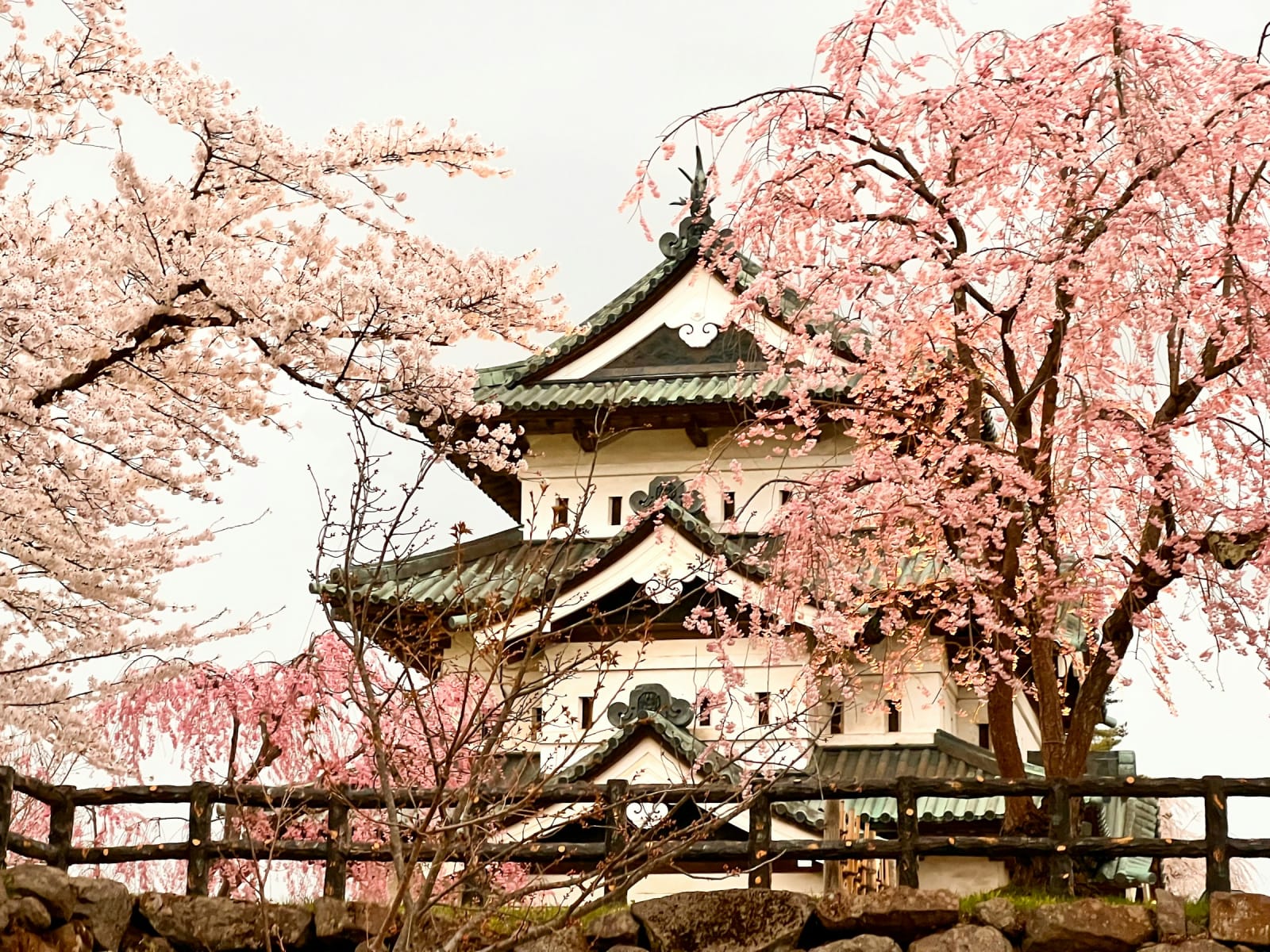
Hirosaki Castle
弘前城
Tohoku's only original castle keep, ringed by 2,600 cherry trees whose fallen petals turn the outer moat solid pink in late April
About Hirosaki Castle
Hirosaki's keep is small, three tiers and 14.4 metres, but it is the real thing: built in 1810 and never reconstructed. Plan around the works, though. The interior has been closed since November 2025, and Hirosaki City expects it to stay shut through fiscal 2032. Since July 2026 the keep itself has been moving about 78 metres back onto its rebuilt stone base, where it is due in mid-November; from outside you can see it until a repair shelter goes up around autumn 2028. The park around it is open as usual and is most of the visit: moats, five original gates and three turrets, with Mount Iwaki to the west. The outer grounds are free; ¥320 covers the Honmaru, the inner citadel around the keep.
Essential Tips
The keep's interior is closed through fiscal 2032, so the ¥320 Honmaru ticket buys the grounds and a close view of the keep, not a climb
The Honmaru charges only from April 1 to November 23, 9 AM to 5 PM; it is free from November 24 to March 31, and on the last Sunday of May
If you arrive after the Somei-yoshino peak, head for the weeping cherries in the Honmaru: from 2021 to 2026 they reached full bloom three to six days later
In the festival the park is lit from sunset to 10 PM; in 2026 the lights stayed on until 11 PM from April 15 to 19
During the festival, boatmen also pole wooden boats along the middle moat (¥1,500 adults in 2026), if you would rather not row yourself on the West Moat
Until about March 31, 2027, part of the Honmaru's south side is closed for the keep works, and a temporary staircase takes you around it
Carry cash: some ticket booths in the park take nothing else
The 100 Castles stamp is at the Hirosaki Castle Information Center, opposite the Gejo-bashi bridge, and at Midori no Sodanjo; the gojoin (castle seal) is sold only at the Information Center, including a ¥1,000 keep-return edition through March 2027
Drones need the city's permission to fly in the park, and dogs can come in only in a cage, a cart or your arms
Hirosaki's hotels fill up months before the Cherry Blossom Festival; book as soon as your dates are fixed
Don't Miss
Hanaikada: the Petal Carpet on the Outer Moat
In the days after full bloom, fallen petals pack the outer moat so tightly that the water disappears under pink. This is the Hirosaki picture, and it is outside the paid area, so it costs nothing to see. The wind decides where the petals pile up, so walk the moat before you settle on a spot. During the 2026 festival, three stretches of the moat bank between the East Gate and the courthouse, normally closed, open as photo spots.
The Keep Back on Its Own Walls
For eleven years the keep sat on a temporary base in the middle of the Honmaru while the stone wall under its corner was taken apart and rebuilt. It is due back on that wall in mid-November 2026, which makes the blossom seasons of 2027 and 2028 the ones to see it in place, before a repair shelter covers it around autumn 2028. Look at it from inside the Honmaru and from across the inner moat, and expect company in the frame: a work platform stands in the moat below the keep until the repairs are done, and in 2027 it hides part of the first floor.
The West Moat Cherry Tunnel
Cherry trees planted along both banks of the West Moat arch over the paths, and in blossom season this is the park's cherry tunnel. During the festival you can rent a rowboat (¥1,500 an hour for up to three people in 2026) and see both banks from the water, and after dark the lit trees reflect in the moat. It is all outside the paid area.
Gates and Turrets from 1611
Five gates and three corner turrets date from the castle's first years, and all are Important Cultural Properties. The gates are built with masugata, walled boxes that made attackers stop and turn under fire before the next gate. The Otemon on the south side is the main entrance today, but when the castle was built the front gate was the Kamenoko Gate to the north; it and the East Inner Gate are under repair until March 2027 and still open to walk through. The south-west turret has been fenced off since heavy snow damaged it in January 2025.
Autumn Leaves and Snow Lanterns
The Chrysanthemum and Autumn Leaves Festival runs from October 30 to November 8 in 2026, and the maples and cherry trees are lit from 4 PM to 9 PM into mid-November. The Snow Lantern Festival (February 10 to 14 in 2027) sets about 150 snow lanterns around the park and 300 candle-lit mini snow huts around the lotus pond, which you look down on from the Honmaru with Mount Iwaki behind. At night the snow-covered keep and the old pines are lit.
What to Do Here
Sunrise Hanaikada Walk
Walk the outer moat at first light, when the petal carpet is undisturbed and the paths are nearly empty, then cut through the park to the West Moat's cherry tunnel. During the festival the Honmaru can also be entered outside its paid hours, so you can finish at the keep with Mount Iwaki behind it before the ticket booths open at 9 AM.
Tips:
- Hirosaki City publishes its own bloom reports for the park; go by those, not a national forecast
- The loop bus does not start until 10 AM, so walk from the station (30 to 35 minutes) or take a taxi (10 minutes)
- Late-April mornings in Tsugaru are cold; bring a warm layer
Full Park Loop on the ¥520 Combined Ticket
Enter by the Otemon, cross the moats to the Honmaru for the keep and the view west to Mount Iwaki, carry on north through the Kita-no-kuruwa to the Kamenoko Gate, and loop back to the Botanical Garden. Finish across the road at Fujita Memorial Garden, a Taisho-era villa garden with a Western-style house and its own view of Mount Iwaki. One ¥520 ticket covers all three paid areas for the day.
Tips:
- The combined ticket saves ¥440 on three single tickets (¥320 each)
- It is sold at the Botanical Garden, the park's ticket booths and Fujita Memorial Garden
- The Botanical Garden and Fujita Memorial Garden open from mid-April to November 23; out of season the loop is the free park plus the Honmaru
- Break at the Butokuden rest house in the Kita-no-kuruwa, open all year, for soba or a tasting set of apple pies
Watch the Keep Move (Autumn 2026)
Hirosaki City is running the return as open works and posts the moving schedule online two weeks at a time. Jacks push the keep along rails on rollers, about 30 centimetres a stroke, and the last moves onto the rebuilt base are planned for October and November 2026. Combine a visit with the Chrysanthemum and Autumn Leaves Festival (October 30 to November 8) and the evening light-up.
Tips:
- Check the city's schedule PDF before you go: work days shift with the weather, and some weeks go on laying rails rather than moving
- From November 24 the Honmaru is free, and the keep is due to be back on its base by then
- In August 2026 about 3,600 people, school pupils included, hauled the keep 4.17 metres by rope over seven days
Plan Your Visit
Opening Hours
honmaru
Honmaru and Kita-no-kuruwa (the paid inner area): 9:00 AM – 5:00 PM from April 1 to November 23. In the 2026 Cherry Blossom Festival the paid hours ran to 9:00 PM from April 17 to 30, and you could also enter outside the paid hours.
winter
November 24 to March 31: the Honmaru and Kita-no-kuruwa are free.
keep
Keep interior closed since November 24, 2025; Hirosaki City's current plan keeps it shut through fiscal 2032 while the keep is reinforced and repaired.
park
Outer grounds, moats and the outer gates: free.
Best Time to Visit
The second half of April, for the cherry blossoms. Somei-yoshino full bloom began between April 13 and April 23 in every year from 2021 to 2026, and from 2023 to 2026 the petal carpet on the outer moat formed one to three days later and lasted four to seven days. Be at the moat early in the morning. Second choice: late October to mid-November, when about 1,100 maples and the cherry trees turn and the park is lit in the evenings.
Avoid:
Cherry Blossom Festival weekend afternoons and Golden Week; the 2026 festival ran April 10 to May 5
Nearby
Tsugaru-han Neputa Mura
Year-round home of Hirosaki's fan-shaped Neputa festival floats, with a full-size float on display and live Tsugaru shamisen every day; 5-6 minutes on foot from the park's North Gate or East Gate.
900 m
Fujita Memorial Garden
A 2.18-hectare garden laid out in the Taisho era as the villa of Hirosaki-born businessman Fujita Ken'ichi, a 7-minute walk from the Otemon; ¥320, or on the combined ticket.
900 m
Hirosaki Castle Botanical Garden
About 1,500 plant species on 7.65 hectares of the Sannomaru, and the main venue of the Chrysanthemum and Autumn Leaves Festival; ¥320.
Inside the park
Nakamachi Samurai District
The preserved samurai quarter north of the park, where the castle's retainers lived, now a protected district of samurai houses; free to walk.
800 m
Gallery

Hanaikada means flower raft: the petals drift and pile up wherever the wind pushes them

The roofs are copper-tiled rather than clay, a choice made for the Tsugaru cold

Outside blossom season the West Moat is quiet; mandarin ducks raise their young on it in early summer

Hirosaki has held its Snow Lantern Festival every February since 1977
History
founding
Tsugaru Nobuhira, the second lord of the Hirosaki domain, completed the castle in 1611 on the site his father Tamenobu had chosen. Its first keep, five tiers high in the south-west corner of the Honmaru, caught fire when lightning struck in 1627 and was lost when the gunpowder stored inside exploded. The domain went almost two centuries without a keep.
significance
The present keep went up in 1810. The ninth lord, Tsugaru Yasuchika, got the shogunate's permission by calling it a rebuilt corner turret, at a time when his domain was guarding Ezo (Hokkaido) for the shogunate and Russian ships were passing through the Tsugaru Strait. Officially it stayed a turret, which is why it is so compact at 14.4 metres, with gables and bay windows only on the east and south faces that looked out of the castle. Hirosaki escaped the air raids of 1945, and the keep, three turrets and five gates still stand; it is the only original keep in Tohoku.
reconstruction
The east face of the Honmaru wall under the keep had been bulging for years, and in 2011 the city decided to take it apart. In 2015 the keep was jacked up and moved about 78 metres to a temporary base in the centre of the Honmaru; 2,185 numbered stones came down between 2016 and 2018 and were relaid from 2021 until the last one went back in December 2024. It had happened once before: after part of the wall collapsed in 1896, master carpenter Horie Sakichi hauled the keep aside in 1897, and the current return, due on the base in mid-November 2026, is the first in 111 years.
name Origin
The castle was built as Takaoka Castle, after the old name of the site. The town and the castle were renamed Hirosaki in 1628, the year after the fire that destroyed the first keep.
Getting There
Dotemachi Loop Bus from Hirosaki Station
Station: Hirosaki Station to Shiyakusho-mae (Konan Bus)
Exit: Otemon gate, 3 minutes from the stop
Walk: 3 minutes to the Otemon, then 700 metres through the park to the keep
Departs every 10 minutes from 10 AM to 6 PM (to 5 PM December to March) and takes 16 minutes to Shiyakusho-mae. The loop runs one way, so for the ride back use the Bunka Center-mae stop near the East Gate: 12 minutes to the station. Extra evening runs are added for the autumn light-up.
Walking from Hirosaki Station
Station: Hirosaki Station (JR Ou Line)
Exit: Head west through the Dotemachi shopping street
Walk: 30 to 35 minutes (2.6 km) to the Otemon
Before 10 AM, when the loop bus starts, this or a 10-minute taxi ride is the way in, which matters for an early visit in blossom season.
Tohoku Shinkansen from Tokyo
Station: Tokyo to Shin-Aomori (Hayabusa), then JR Ou Line to Hirosaki
Exit: Change at Shin-Aomori
Walk: 30 to 35 minutes on foot or 16 minutes by loop bus from Hirosaki Station
The Hayabusa takes 2 hours 59 minutes at best to Shin-Aomori, and Ou Line trains take 25 to 40 minutes on to Hirosaki, plus the wait for the connection. A day trip from Tokyo is possible but tight; in blossom season, stay the night so you can be at the moat early.
Location
1 Shimoshirogane-cho, Hirosaki, Aomori 036-8356
Nearest: Hirosaki Station (JR Ou Line) (2.6 km, 30 to 35 minutes on foot to the Otemon gate, or 16 minutes on the Dotemachi loop bus plus a 3-minute walk)
Book tours & activities near Hirosaki Castle
via Klook
Find nearby hotels in Hirosaki Park
Compare prices across booking sites
More Attractions
Senso-ji Temple
Tokyo's oldest temple: a 645 AD Buddhist site with a lantern-hung gate, 89-shop street, and 30 million visitors a year
Tokyo Skytree
634 meters of Tokyo: Japan's tallest structure with two observation decks and Mount Fuji visible on clear winter days
Meiji Shrine
A 175-acre forest in central Tokyo holding a Shinto shrine dedicated to Emperor Meiji, who opened Japan to the modern world
teamLab Borderless
Step into a surreal world where digital art comes alive around you
teamLab Planets
Walk through water, wade through flowers, and lose your sense of where the art ends and you begin
Shimanami Kaido
A cycling guide to Japan's greatest ride: 70km island-hopping across the Seto Inland Sea
Shibuya Crossing
The world's busiest pedestrian crossing, and Tokyo's most iconic spectacle
Shibuya Sky
Tokyo's best observation deck: open-air rooftop with nothing between you and the city
Ghibli Museum
The museum Miyazaki designed himself: no door sales, timed entry, no photography inside, and a life-size Robot Soldier on the roof
Imperial Palace & East Gardens
The emperor's residence at the center of Tokyo: free East Gardens on 400-year-old castle grounds, and a 5 km moat walking loop
Tsukiji Outer Market
Tokyo's greatest food market: fresh sushi, street food, and culinary chaos since 1935
Toyosu Fish Market
Tokyo's modern wholesale fish market: tuna auctions behind glass and sushi breakfast on the upper floors
Shinjuku Gyoen National Garden
Three gardens in one: Tokyo's most celebrated park and its greatest cherry blossom destination
Tokyo Tower
Tokyo's original icon: cheaper, less crowded, and more romantic than the Skytree
Ueno Park & Museums
Tokyo's cultural centre: four national museums in one park, plus cherry blossoms that draw over 2 million visitors
Akihabara Electric Town
Tokyo's otaku hub: anime, electronics, retro games, and maid cafés stacked floor to ceiling
Tokyo Disney Resort
Two world-class theme parks: Disneyland for the classics, DisneySea for the most beautiful Disney park ever built
Fushimi Inari Taisha
Ten thousand vermillion gates winding up a forested mountain: Japan's most-visited Shinto shrine
Kinkaku-ji (Golden Pavilion)
A gold-leaf temple reflected in a mirror pond: Kyoto's most-reproduced image
Kiyomizu-dera
Kyoto's hilltop temple with a wooden stage that floats above the treetops
Arashiyama Bamboo Grove
Five hundred metres of bamboo reaching 20 metres overhead, filtering light to green: free, open at dawn, packed by 9 AM
Arashiyama Monkey Park Iwatayama
Wild macaques on a mountain overlooking Kyoto: the monkeys roam free and you're the one in the cage
Nijo Castle
The shogun's Kyoto stronghold: nightingale floors, golden screens, and 400 years of power politics
Nishiki Market
Kyoto's kitchen for 700 years, five blocks of pickles, tofu, and things you have never tasted before
Ryoan-ji Temple
Fifteen stones in white gravel, only fourteen visible from any angle, and no one knows what it means
Philosopher's Path
A 2-kilometer canal walk named after a philosophy professor who thought here every morning for 30 years
Osaka Aquarium Kaiyukan
Eight floors spiraling down around a Pacific Ocean tank big enough to hold whale sharks
Osaka Castle
Toyotomi Hideyoshi's fortress: the castle that unified Japan, surrounded by the city's finest park
Kuromon Market
Osaka's kitchen: a 200-year-old market where chefs and visitors eat the city's freshest seafood
Sumiyoshi Taisha
Japan's oldest shrine architectural style and its most striking arched bridge: a world away from the tourist trail
Universal Studios Japan
Super Nintendo World, the Wizarding World, and one of Asia's best theme parks: all in Osaka Bay
Nara Park
Over 1,200 wild deer roam freely: bow to them and they'll bow back for a cracker
Todai-ji Temple
The world's largest wooden building and a 15-metre bronze Buddha: scale that leaves you speechless
Kasuga Grand Shrine
Three thousand lanterns lining a forest path to the shrine that has protected Nara since 768 AD
Kamakura Great Buddha (Kotoku-in)
A 13th-century bronze Buddha, 11 meters tall, that has sat in the open air since a storm destroyed its hall in 1498
Tsurugaoka Hachimangu Shrine
The shrine at the center of Kamakura: a 1.8-kilometer approach from the sea, two clan ponds, and yabusame horseback archery since 1192
Hasedera Temple
A 9-meter gilded Kannon statue, hydrangea season that draws thousands, and an ocean view that makes the climb worth it every day
Hokokuji Temple
Two thousand bamboo stalks, a tea house inside the grove, and a quieter alternative to Kyoto's famous bamboo
Enoshima Island
A 4-kilometer island with a three-part shrine, sea caves, a lighthouse, and more cats per square meter than almost anywhere
Nikko Toshogu Shrine
Japan's most extravagant shrine: 55 gold-lacquered buildings, 5,000 carvings, and the tomb of the shogun who unified Japan
Kegon Falls
A 97-meter waterfall from Lake Chuzenji, with a paid elevator to the base and a winter freeze that turns it into a wall of ice
Lake Chuzenji
A volcanic caldera lake at 1,269 meters, the source of Kegon Falls, and Nikko's best place for autumn foliage views over open water
Hakone Shrine
A 1,200-year-old mountain shrine on Lake Ashi, best known for a red torii gate that rises directly from the water
Owakudani
An active volcanic valley on the Hakone Ropeway, with sulfur vents, black eggs boiled in hot springs, and Mt. Fuji overhead on clear days
Kitano Ijinkan
Kobe's hillside district of 19th-century foreign residences: Victorian houses, consulate buildings, and the Weathercock House, from when Kobe was Japan's most cosmopolitan port
Arima Onsen
One of Japan's three oldest hot spring towns: two distinct spring types, 30 minutes from Kobe, with ryokans that have been operating for centuries
Nunobiki Herb Garden
A hillside herb garden above Kobe reached by ropeway, with views over Kobe Bay and the Kii Peninsula, plus Nunobiki Falls on the walk up
Meriken Park & Kobe Port Tower
Kobe's red drum-shaped tower, a quake-scarred wharf left exactly as 1995 left it, and a harbor that lights up at dusk
Cup Noodles Museum
The museum dedicated to instant noodles: design your own Cup Noodle, see the original 1958 kitchen where ramen was invented, and learn why Momofuku Ando changed how the world eats
Yokohama Chinatown
Japan's largest Chinatown: 200+ restaurants in one district established in 1859, with four colored gates and street food around every corner
Sankeien Garden
A 17-hectare garden in Yokohama containing historic buildings relocated from Kyoto and Kamakura, including a 1457 three-story pagoda from a Kyoto temple
Fukuoka Yatai Food Stalls
Fukuoka's open-air food stalls: sit at a counter under a canvas canopy, eat tonkotsu ramen or yakitori, and talk to the owner, Japan's most social street food experience
Kushida Shrine
The central shrine of Hakata: year-round, it holds a 10-meter festival float; in July, the Yamakasa race starts here at 3:59 AM
Ohori Park
A large lake park in central Fukuoka, built on the old castle moat, with a 2-kilometer circuit walk, rental boats, and 1,000 cherry trees
Kenroku-en Garden
Two centuries of Maeda clan garden design: 12,000 trees, the Kotoji-toro lantern, and the only place in Japan where pine trees wear snow ropes in winter
Omicho Market
Kanazawa's 280-year-old fresh food market: Sea of Japan seafood, winter crab, and kaisendon rice bowls eaten in the stall itself
Higashi Chaya District
Kanazawa's largest Edo-period geisha district: a single preserved street of wooden teahouses, gold leaf workshops, and morning calm before the tour buses arrive
Hakone Open-Air Museum
An outdoor sculpture park where kids can run free, adults admire Picasso, and everyone soaks their feet
Hida Folk Village (Hida no Sato)
Over 30 traditional farmhouses from the Japanese Alps, relocated and preserved in one beautiful hillside museum
Hiroshima Peace Memorial Park
The ground zero of the atomic age, transformed into the world's most powerful argument for peace
Hiroshima Castle
The castle built by the Mori clan in 1589, destroyed by the atomic bomb in 1945, and rebuilt in 1958, with a museum that covers both its feudal history and the destruction that ended it
Itsukushima Shrine
A shrine built on stilts over the sea, where the tide decides whether the great torii floats or stands on open sand
Korakuen Garden
Wide open lawns, a working tea field, and the black keep of Okayama Castle borrowed as scenery across the Asahi River
Rinno-ji Temple
Nikko's founding temple, where three 8-metre gilded deities stand in for the sacred mountains above the valley
Jigokudani Monkey Park
The only place on Earth where wild monkeys soak in a natural hot spring, at the end of a snowy forest trail
Zenko-ji Temple
A 1,400-year-old temple where the day begins at dawn and salvation is a metal key you find in total darkness
Matsumoto Castle
Japan's oldest five-tiered castle keep, black-walled and moat-ringed, with the Northern Alps stacked up behind it
Nagoya Castle
The keep is closed, and the real treasure is next door: a palace rebuilt plank by plank in hinoki and gold leaf
Ise Grand Shrine (Ise Jingu)
Japan's most sacred Shinto site, rebuilt from scratch every 20 years for 1,300 years so it is forever both ancient and new
Glover Garden
The mansions of Nagasaki's foreign merchants, gathered on a harbor hillside around Japan's oldest Western house
Tsutenkaku Tower
Osaka's retro tower in the Shinsekai neighborhood: 103 meters of 1950s neon nostalgia, the Biliken luck statue, and kushikatsu restaurants on every surrounding block
Shitenno-ji Temple
One of Japan's oldest Buddhist temples, founded 593 AD by Prince Shotoku, with a stone torii gate, a five-story pagoda, and the country's longest-running monthly flea market
Pola Museum of Art
A Western art museum embedded in Hakone's beech forest, with Monet, Picasso, and Renoir displayed in a building designed to disappear into the trees
Kanazawa Castle Park
The former seat of the Maeda clan, Japan's most powerful outside the Tokugawa: a free public park with an original 1788 gate, reconstructed towers, and a direct connection to Kenroku-en
21st Century Museum of Contemporary Art, Kanazawa
A glass circle in Kanazawa with a free permanent collection including the famous Swimming Pool illusion, and a building that won SANAA the Pritzker Prize
Maruoka Castle
Hokuriku's only original castle keep: a small tower under 120 tonnes of stone roof tiles, on a hill ringed with cherry trees
Inuyama Castle
Japan's oldest standing castle keep, on a bluff over the Kiso River, with a top-floor balcony you can walk all the way round
Hikone Castle
A National Treasure keep above Lake Biwa, with its gate turrets, moats and even the lords' stable still standing around it
Matsue Castle
The San'in region's only original castle keep, black-boarded and finished in 1611, with small covered boats circling the moats below
Bitchu-Matsuyama Castle
Japan's only original castle keep on a mountaintop, 430 m up, and on some autumn dawns an island in a sea of cloud
Marugame Castle
Four tiers of curving stone walls stacked 60 m high under a small 1660 keep, with the Seto Ohashi bridges on the horizon
Matsuyama Castle
Ride a one-seat chairlift over the treetops to the youngest of Japan's twelve original castle keeps, in the middle of Matsuyama
Uwajima Castle
A small keep built to impress in the 1660s, on the wooded hill of a five-sided castle that a shogunate spy took for a square
Kochi Castle
The only original castle keep still joined to its lord's palace, on a hill above the avenue where Kochi holds its Sunday Market