About Arashiyama
Arashiyama has been a retreat for over a thousand years. Heian-era aristocrats built villas here to escape the capital's summer heat, poets wrote about the mountains above the Hozu River, and the area accumulated temples, shrines, and gardens across the centuries. Today it is one of the most visited districts in Kyoto, and the bamboo grove photographs are everywhere, but arriving early on a weekday morning still gives you something real: wind through bamboo, no crowd noise, and the sense of being in a place that has mattered to people for a very long time.
The bamboo grove path runs about 500 meters between Tenryu-ji's north gate and Okochi Sanso Villa, and the optimal window is before 7 AM. By 9 AM it is a human highway. Immediately adjacent is Tenryu-ji, a UNESCO World Heritage Zen temple founded in 1339, whose Sogen-chi garden uses shakkei (borrowed scenery) to incorporate the Arashiyama mountain into the design. The garden admission is ¥500; the full temple building access is ¥800. Walk south from Tenryu-ji to reach Togetsukyo Bridge, the 155-meter wooden span over the Hozu River named "Moon Crossing Bridge" by Emperor Kameyama. From the far side, the 20-minute uphill hike to Iwatayama Monkey Park reaches 120-plus wild Japanese macaques: the feeding area is a caged hut where you are inside and the monkeys roam freely outside. The views of Kyoto from the summit are among the best in the city.
Beyond the main circuit there is more: Gio-ji, a small thatched hermitage ten minutes north with a moss garden that sees almost no one compared to the bamboo grove; Jojakko-ji Temple on the hillside above for autumn foliage; the Sagano Scenic Railway (Torokko) along the Hozu River gorge for a 25-minute mountain train ride; and Saiho-ji (the Moss Temple, advance reservation required) for a special-access moss garden that most visitors never see. The Hozu River boat ride, a two-hour downstream journey from Kameoka to Arashiyama, is best in the morning before you have already walked all day. Allow a full day; two days reveals the quieter temples beyond the tourist circuit. Higashiyama, Kyoto's other major sightseeing corridor, is about 50 minutes by bus or taxi if you want to combine districts.
Don't Miss
Bamboo Grove Before 7 AM
The bamboo grove is 500 meters long and free, and the path is public at all hours. By 9 AM it is too crowded to feel like anything except a queue. Before 7 AM on a weekday it is a different experience: the stalks creak in the wind, the light is green and diffuse, and you can stop and stand still without blocking anyone. The path runs from Tenryu-ji's north gate north to Okochi Sanso Villa. Walk it, turn around, walk it again. The whole thing takes 15 minutes at a normal pace. Do it at the right time and it is one of the most distinctive natural experiences in Japan.
Tenryu-ji Temple Garden
The Sogen-chi garden at Tenryu-ji, designed by Muso Soseki in 1339, is considered one of Japan's finest Zen gardens and is the reason Tenryu-ji is a UNESCO World Heritage site. The specific technique is shakkei (borrowed scenery): the garden uses the Arashiyama mountain behind it as a backdrop, so the mountain appears to be part of the composition. The pond, rocks, and tree placement are all designed around that fixed natural element. Garden admission is ¥500; add the main hall (Hojo) for ¥800 total. Opens at 8:30 AM, so pair with the bamboo grove immediately before.
Iwatayama Monkey Park
The 20-minute hike from the base near Togetsukyo Bridge is uphill and requires proper footwear, but the summit has two things most Arashiyama visitors miss: 120-plus wild Japanese macaques roaming freely around you, and a panoramic view of central Kyoto that most viewpoints in the city cannot match. The feeding area reverses the usual zoo setup: you enter a wire-mesh hut and pass food through the mesh to macaques outside. Keep food and eye contact out of sight outside the hut. Admission ¥600. Open 9 AM to 4 PM (extended hours in summer). Best visited mid-morning when the monkeys are most active.
A Full Day in Arashiyama
Bamboo grove at dawn, temple garden, monkey mountain, and the quieter temples beyond the crowds
Bamboo Grove
Arrive at the grove entrance near Tenryu-ji's north gate by 6:45 AM. Walk north through the 500-meter path to Okochi Sanso Villa gate, then turn around and walk back. In this window you will likely encounter fewer than a dozen other people. The stalks are 30 meters tall and the light at this hour is green and indirect. This is the specific thing you came for: do not skip the early start.
💡 Tip
- • Free, no gate or ticket
- • No lights or special access needed: it is public space
- • Most people arriving at 9 AM will not experience what you will experience now
Gio-ji Hermitage
Walk 10 minutes north from the bamboo grove to Gio-ji before the main crowds arrive. This small thatched hermitage was built in the 12th century and is named for a shirabyoshi dancer mentioned in the Tale of the Heike. The moss garden covering the courtyard is dense and green year-round. Almost no one from the bamboo grove makes this detour. Admission ¥300, opens at 9 AM, so arrive just at opening.
💡 Tip
- • ¥300 entry
- • Opens 9 AM: time your bamboo grove walk to finish by then
- • If it is raining the moss looks even better
Tenryu-ji Temple Garden
Return south to Tenryu-ji as it opens at 8:30 AM. Enter via the south garden gate and circuit the Sogen-chi pond garden. Spend 20 minutes watching how the framing of the Arashiyama mountain changes as you walk the perimeter: this is the shakkei principle at its most deliberate. The Hojo (main hall) interior is worth the extra ¥300 for the fusuma paintings if you have interest in Zen temple architecture.
💡 Tip
- • ¥500 garden only, ¥800 with Hojo
- • Opens at 8:30 AM sharp: early arrivals wait outside the south gate
- • The north exit leads directly back to the bamboo grove
Togetsukyo Bridge and Hozu River
Walk south 10 minutes to Togetsukyo Bridge. Cross the 155-meter span and stand on the far side looking back at the mountains. In cherry blossom season (late March to early April) the riverbanks are lined with trees and this view is Arashiyama's most photographed. The base of Iwatayama Monkey Park is a five-minute walk from the south end of the bridge on the far bank.
💡 Tip
- • Free to cross
- • Boat rentals available on the north bank: ¥1,000-1,500 per hour for rowboats
- • The bridge is less crowded at 9:45 AM than at 11 AM by a significant margin
Iwatayama Monkey Park
Hike up from the ticket booth at the base of the mountain near Togetsukyo Bridge. The path is 20 minutes uphill with clearly marked switchbacks and benches at intervals. At the top: 120-plus wild macaques, the wire-mesh feeding hut, and a panoramic view over central Kyoto that includes Kyoto Tower and, on clear days, Osaka in the distance. Keep food and food packaging inside the hut and out of sight on the path up.
💡 Tip
- • ¥600 admission, pay at the base ticket booth
- • Feeding food costs ¥100 (sold inside the hut)
- • Comfortable shoes required: the path is unpaved and sometimes muddy after rain
- • Do not make direct eye contact with macaques outside the hut
Lunch
Descend and choose between two strong lunch options: Arashiyama Yoshimura for handmade soba with Togetsukyo Bridge views (popular, expect a short wait, ¥1,500 to ¥2,500), or Shigetsu inside Tenryu-ji for traditional shojin ryori (Buddhist vegetarian cuisine, ¥3,500 to ¥5,000, reservation recommended). Both are excellent and the shojin ryori gives you a reason to re-enter Tenryu-ji at a quieter midday hour.
💡 Tip
- • Yoshimura is walk-in; Shigetsu takes reservations and is calmer
- • Both have English menus or picture menus
- • Avoid the tourist trap restaurants on the main shopping street: prices are high and quality is generic
Jojakko-ji Temple or Sagano Scenic Railway
Choose based on interest. Jojakko-ji Temple (¥500) is a 10-minute walk up a residential lane from the bamboo grove area: a hilltop temple with a five-story pagoda, excellent mountain views, and in November, the best autumn foliage in the area. The Sagano Scenic Railway (Torokko) is a 25-minute open-air train ride along the Hozu River gorge departing from Saga-Arashiyama Torokko Station: ¥880 one way, book the return in advance. Both work as a gentle afternoon activity after the morning circuit.
💡 Tip
- • Jojakko-ji: ¥500, 10 min walk from bamboo grove, closes at 5 PM
- • Sagano Torokko: ¥880 one way, departs roughly hourly, tickets sell out in autumn and spring
- • The Torokko and Jojakko-ji can be combined if you are not tired from the morning
Top Attractions
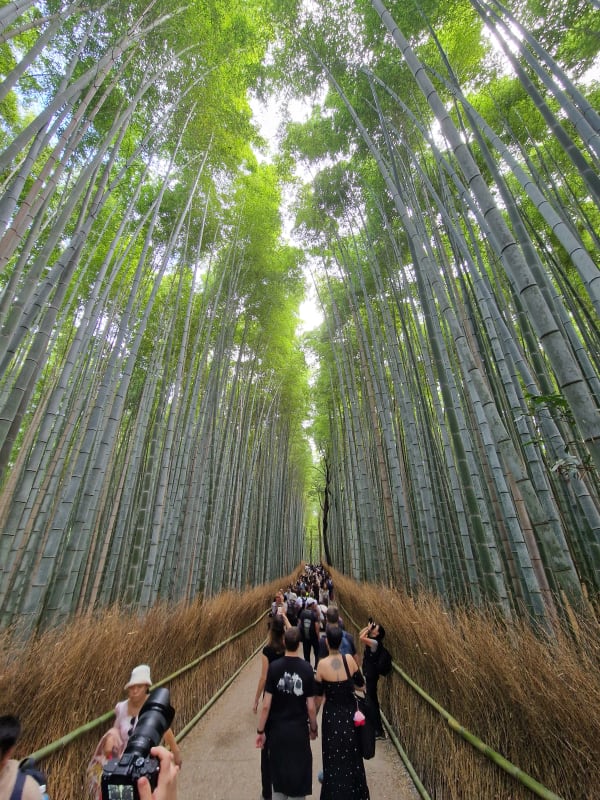
Arashiyama Bamboo Grove
A 500-meter public path through Moso bamboo stalks reaching 30 meters tall, running between Tenryu-ji's north gate and Okochi Sanso Villa. Free and accessible at any hour. The grove is genuinely extraordinary in the early morning, when wind moves through the stalks and the light is indirect and green. From 9 AM onward it is one of the most densely crowded tourist paths in Japan. The sound of bamboo in wind is part of the experience: the Environment Agency of Japan has designated it one of the country's 100 soundscapes worth preserving.

Tenryu-ji Temple
Founded in 1339 by shogun Ashikaga Takauji and designed by Zen master Muso Soseki, Tenryu-ji is a UNESCO World Heritage site and the head temple of the Tenryu-ji school of Rinzai Zen. The Sogen-chi garden is its defining achievement: a pond garden that uses shakkei (borrowed scenery) to incorporate Arashiyama mountain as a permanent backdrop. The result is a composition where natural and designed elements are indistinguishable. The Hojo (main hall) contains large-scale ink paintings on fusuma (sliding door panels). Garden admission ¥500; full access including Hojo ¥800. Opens at 8:30 AM.

Togetsukyo Bridge
The 155-meter wooden bridge spanning the Hozu River was named 'Moon Crossing Bridge' by Emperor Kameyama in the 9th century when he watched the moon appear to cross the structure. The current structure dates from 1934 but maintains the historical appearance. The bridge frames the Arashiyama mountain on one side and flat Kyoto cityscape on the other. During cherry blossom season the riverbanks bloom simultaneously, making this the single most photographed view in Arashiyama. Boat rentals are available on the north bank for a different angle.

Iwatayama Monkey Park
A wildlife park on the forested hillside above Togetsukyo Bridge where approximately 120 wild Japanese macaques (Macaca fuscata) roam freely. The 20-minute uphill hike on a maintained trail reaches the summit, where a wire-mesh feeding hut lets visitors offer apple slices and other food through the mesh to monkeys on the outside. The arrangement reverses the usual zoo dynamic. The summit also provides one of the best elevated views of central Kyoto available without a tower, including Kyoto Tower and the urban grid extending east. Best in the morning when the macaques are most active.

Gio-ji Temple
A small thatched hermitage set in a dense moss garden in the quiet north of the Arashiyama district, a 10-minute walk from the bamboo grove. Named for a shirabyoshi dancer from the Tale of the Heike who retreated here in the 12th century, the temple is maintained as a hermitage rather than a formal religious institution. The courtyard moss is thick and green year-round. Visitor numbers are a fraction of the bamboo grove: in the early morning, you will likely be one of three or four people inside. Admission ¥300.

Jojakko-ji Temple
A hilltop temple above the Sagano residential area, best known for its autumn maple foliage (November) and its five-story pagoda, which provides elevated views over the valley and toward central Kyoto. The approach climbs stone steps through a forested hillside. Less visited than Tenryu-ji and with genuine height-for-views that most Arashiyama temples lack. The moss-covered grounds also have some of the best spring green light in the district.
Highlights of Arashiyama
- ✓Bamboo grove: 500-meter path through 30-meter-tall stalks, free, best before 7 AM when it is genuinely quiet
- ✓Tenryu-ji (founded 1339, UNESCO): garden uses Arashiyama mountain as a design element via shakkei, ¥500 garden or ¥800 with temple buildings
- ✓Togetsukyo Bridge: 155-meter wooden span named 'Moon Crossing Bridge' by Emperor Kameyama, free to cross
- ✓Iwatayama Monkey Park: 20-minute hike to 120-plus wild macaques; humans feed from inside a caged hut on the summit
- ✓Sagano Scenic Railway (Torokko): 7km train along the Hozu River gorge, ¥880 one way, books out in peak season
- ✓Gio-ji hermitage: moss garden with thatched roof cottage, ¥300, a fraction of the bamboo grove crowds
Related Articles
Japan in January: New Year, Powder Snow and Empty Temples
Three days of New Year crowds and closures, then the cheapest, quietest month of the entire year: peak powder, the clearest Fuji views, sumo in Tokyo, and onsen at their best.
Japan in March: Sakura Timing, Weather and What to Expect
Early March is quiet late winter with plum blossoms. Late March is the start of cherry blossom season, with prices to match. When the sakura actually open, and how to book without gambling.
Japan in April: Cherry Blossoms, Weather and What to Expect
Peak sakura in Tokyo and Kyoto, hanami picnics under the petals, and the year's biggest crowds to match. Bloom timing week by week, plus the Golden Week trap to avoid.
Other Kyoto Districts
Shibuya
Shibuya Crossing, where 3,000 pedestrians cross simultaneously, and the neon-lit backstreets of Tokyo's youth culture engine
Shinjuku
Free 45th-floor views, 200+ bars crammed into Golden Gai's six alleys, and 1,173 cherry trees in Shinjuku Gyoen
Harajuku
Takeshita-dori, Meiji Shrine's forest, and Cat Street: three completely different worlds within a 15-minute walk
Asakusa
Tokyo's Edo holdout: Senso-ji temple, 89-shop Nakamise-dori, and backstreets that refused to modernize
Ginza
The Wako clock tower at 4-chome, kabuki from ¥1,000 at Kabuki-za, and the deepest department store food halls in Japan
Ueno
World-class museums, a sprawling park, and one of Tokyo's best street markets
Akihabara
Tokyo's electric playground: anime, electronics, and otaku culture at full volume
Ikebukuro
Budget base on the Yamanote Line: rooftop aquarium, a nine-floor anime store, and Tokyo's densest ramen street
Roppongi
World-class art by day, Tokyo's most international nightlife by night
Odaiba
Tokyo's waterfront playground: digital art, a 20m Gundam, and Rainbow Bridge views across the bay
Tsukiji
Tokyo's kitchen: where the world's freshest seafood meets century-old market culture
Shimokitazawa
Tokyo's indie heart: narrow streets, vintage shops, live-music bars, and ¥900 curry
Chiyoda
Imperial Palace gardens, Edo Castle ruins, and 5km of Tokyo's most scenic moat-side running
Nihonbashi
Tokyo's original centre: Edo-era merchants, Michelin-star restaurants, and Tokyo Station's hidden food halls converge
Yanesen
Old Tokyo preserved: temple lanes, cat-spotting, and ¥200 street snacks in a neighbourhood that skipped the 20th century
Ebisu & Daikanyama
Tokyo's upscale-casual quarter: craft cocktails, curated bookshops, and the kind of dinner you'll remember for years
Nakano
The collector's Akihabara: Nakano Broadway's labyrinthine floors of rare figures, vintage manga, and otaku treasures at better prices
Ryogoku
Sumo heartland: where 300kg wrestlers train, chanko-nabe simmers, and Edo history fills Japan's best museum
Koenji
Tokyo's punk-rock thrift shop: vintage clothing capital, live music dives, and the wildest summer festival you've never heard of
Kichijoji
Tokyo's most liveable neighbourhood: Inokashira Park, the Ghibli Museum, and the kind of Sunday afternoon you'll wish you had at home
Gion
~80 invitation-only ochaya teahouses, Gion Matsuri since 869 CE, and a daily window at 5:30 PM when Kyoto's geiko and maiko take to the streets
Higashiyama
Kiyomizu-dera's 13-meter wooden stage, stone lanes under a 1976 preservation order, and 50-plus temples along a 2-kilometer eastern hillside: arrive before 8 AM
Fushimi
10,000 vermillion gates on a forested mountain, and Kyoto's oldest sake district below
Kinkaku-ji Area
Three UNESCO World Heritage temples within walking distance, anchored by a gold-leaf pavilion reflected in a mirror pond
Downtown Kyoto
Kyoto's living room: Nishiki Market, Pontocho alley, and the Kamo River at sunset
Dotonbori
Osaka's neon-lit entertainment heart where food, fun, and flashy signs collide
Shinsekai
Step back in time to retro Osaka - kushikatsu, Tsutenkaku Tower, and the lucky Billiken
Umeda
Northern Osaka's bustling business and shopping hub where modern meets underground
Tennoji
Where ancient temples meet modern skyscrapers: Osaka's perfect blend of old and new
Namba
Osaka's central crossroads: Shinsaibashi shopping, Hozenji Yokocho charm, and trains to everywhere
Amerikamura
Osaka's youth-culture playground: vintage shops, street art, and Triangle Park people-watching
Hakata
Ramen birthplace, a 1,260-year-old shrine, and a festival race that starts at 4:59 AM in the dark
Tenjin
Fukuoka's commercial center: 590 meters of underground shopping, Kyushu's finest depachika, and bar alleys that fill from 6 PM
Nakasu
A 500-meter island that runs on a different clock: quiet by day, yatai stalls and neon after 6 PM
Ready to Experience Arashiyama?
Add a stay in Arashiyama to your trip — we'll suggest activities and help you find hotels in the area.